
Mountains and Vast Landscapes – Nature's Grand Scale
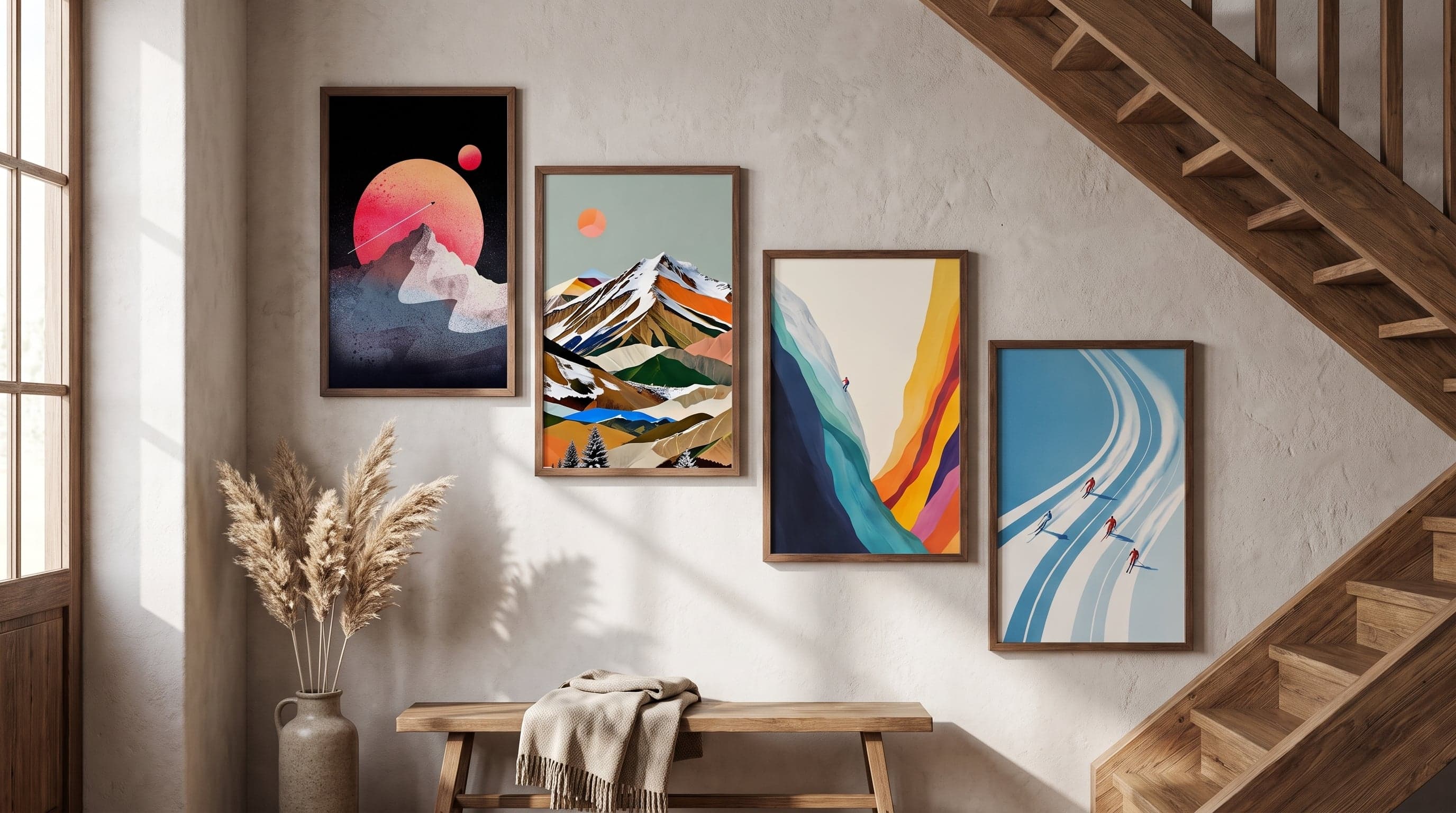
There's something about mountains that makes us feel small without diminishing us. The German Romantics were already painting their wanderers with their backs turned toward peaks they would never reach, and ever since, the motif has carried the same dual charge: admiration and submission, longing and distance. The mountain is nature's superlative – the one element in the landscape that literally points upward, toward something greater than ourselves.
But the mountain is also the landscape of solitude. Unlike the density of the forest or the ceaseless motion of the sea, a mountain peak rarely offers company. It stands unmoved by weather and centuries alike, while we pass by as temporary observers. That stillness – bordering on the surreal – is precisely what makes the motif so enduringly appealing to artists, photographers, and illustrators who work in vast scale rather than fine detail.
What sets mountain posters apart from other landscape motifs is how often the format itself becomes part of the message. A tall, narrow composition forces height in the same way the subject forces the eye upward. It's the composition's own way of saying: see how small everything else becomes from here.
The Mountain as the Great, Silent Subject
In the history of landscape art, mountains have rarely been allowed to simply be terrain. They've carried meaning – as the border between the known and the unknown, as trial, as a sublime force greater than human will. Caspar David Friedrich's wanderer in the mist may be the most-cited example, but the idea lives on far beyond Romanticism: placing a small human figure against an enormous, immovable mass and letting the contrast do the work.
Contemporary mountain art rarely carries the same pathos, but the same basic structure keeps returning. Photographers and illustrators still work with scale as their primary tool – a lone climber, a tiny cabin, a flock of birds clarifying just how vast everything else is. It's not nostalgia for the 19th century, but a recognition that the mountain remains the landscape that best visualises the relationship between humans and nature.
Height in the Format
It's no coincidence that so many mountain motifs are printed in portrait orientation. A wide, horizontal composition gives landscape and horizon plenty of room to spread out – but a mountain rarely wants to spread out. It wants to rise. A narrow, tall sheet lets the eye travel the same path it would in real life: from the ground upward, toward a peak that often vanishes into haze or cloud before it actually ends.
In several contemporary interpretations, this effect is heightened through abstract and graphic devices – bold colour fields, collage-like surfaces, or almost architectural lines that strip the mountain down to its most essential form: a triangle, a point, an upward direction. The result is posters that function as much as studies in composition as they do depictions of landscape.


The Glamour of Winter Sport in the Mountains
Mountains haven't only served as a stage for solitude. During the first half of the 20th century, the Alps also became a destination for fashionable society, and the travel posters of that era reveal an entirely different side of the motif: sun, snow, and high society sharing the same frame. St. Moritz and Mont Blanc weren't depicted as threats but as invitations – places you travelled to in order to be seen as much as to ski.
This style of vintage mountain landscape art has its own visual language: clean colour fields, stylised figures, an optimism that feels distinctly of its time yet has aged with style. Here, the mountain is still tall and dominant, but it's been tamed by lifts, slopes, and winter tourism – a contrast to the more solitary, contemplative mountain motif that otherwise dominates the genre.


Mist, Haze, and the Mountain in the East
In East Asian visual tradition, the mountain plays a somewhat different role. Where the Western sublime often centres on confrontation – humans against the power of nature – classical Chinese and Japanese mountain painting is built more on coexistence. Peaks dissolve into mist, valleys are suggested rather than described, and the empty space in the image carries as much weight as the painted forms.
This style is echoed in several contemporary mountain posters, where atmosphere takes precedence over detail. The result is vast landscapes that feel gentle rather than dramatic – mountains you sense more than see, shaped by light and moisture as much as by stone.


Monet's Soft Mountain Peaks
Even Impressionism found its way to the mountains, though with a different interest than topographical precision. When Claude Monet painted the landscape around Bordighera and the Nervia valley, it wasn't the height itself that captivated him, but the light breaking against the mountainsides and the colours shifting with the hours of the day. Here, the peaks become more mood than monument – blurred contours in blue, green, and ochre rather than sharply drawn silhouettes.
It's a reminder that mountain landscape art doesn't need scale and drama to work. Sometimes it's enough for the mountain to exist at the edge of the frame, as a soft boundary against the sky, for the entire composition to feel grounded.


Frequently asked questions
- Why does portrait format often suit mountain posters best?
- A narrow, tall format follows the mountain's own upward direction and reinforces the sense of scale in a way that a wider, horizontal format rarely achieves.
- Can different types of mountain motifs be combined on the same wall?
- Yes. Dramatic, graphic mountain peaks work beautifully alongside softer, more atmospheric interpretations – the contrast between sharp and diffuse often creates a more interesting whole than if everything shares the same style.
- Are there mountain posters that don't feel too gloomy or solemn?
- Absolutely. Vintage winter sport posters and more graphic, colourful interpretations give the mountain a playful, optimistic tone quite different from the classic, dramatic landscapes.