
The Forest as Visual Language – Density, Shadow and Stillness
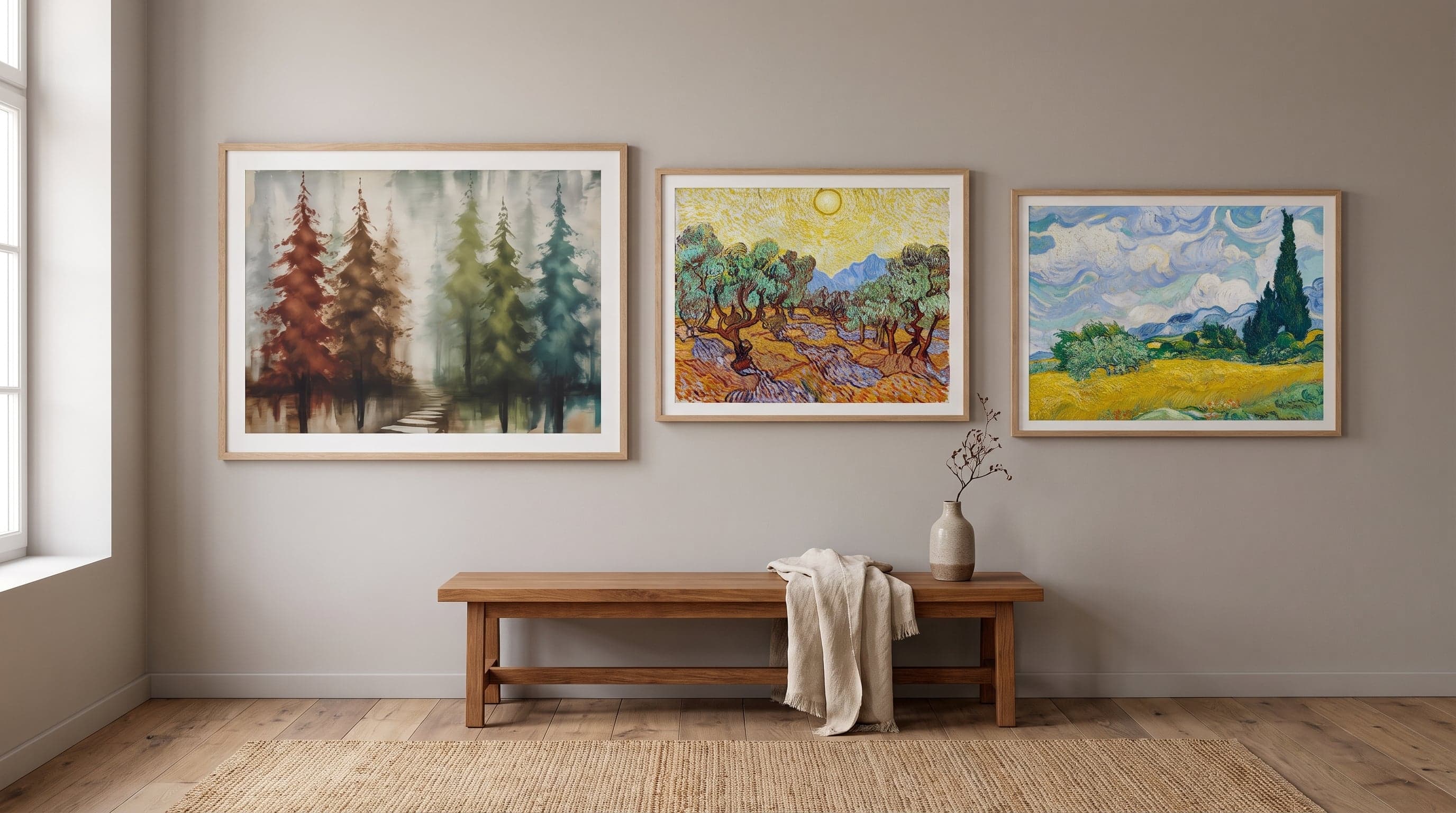
There is a particular silence to the forest motif. Unlike the sea, which is always in motion, or the open expanse of mountains, the forest closes in around the viewer. The trunks form rooms, the foliage filters the light, and what hides behind the next row of trees becomes just as important as what is visible. For centuries, artists have returned to the forest not to depict nature in a general sense, but to explore something harder to put into words: density, shadow, and the kind of stillness that only arrives when the eye is forced to slow down.
A forest poster rarely functions as a decorative landscape in the background. It draws the viewer into an in-between space – between trunk and sky, between light and dark – and it is precisely there, in the incompleteness of what is seen, that the motif's pull lies.
The Architecture of Trees – Trunks, Branches and Light in Forest Motifs
Before the forest becomes atmosphere, it is structure, part of the larger tradition of landscape art where form often precedes mood. The trunk's vertical line, the branching of limbs, the rhythmic repetition of tree after tree – it is a visual language that recalls architecture, though built by time rather than blueprints. Claude Monet understood this when he painted the old oak in the Forest of Fontainebleau: a single tree carrying the entire history of its surroundings in its gnarled bark, while light breaks unevenly across the ground around it.
The same principle recurs in more contemporary interpretations, where the forest's depth is built up through layers of colour rather than detailed drawing. Earthy tones, a hint of mist between the rows of trees, a square composition holding four trees together in close company – all are variations on the same question: how much needs to be visible for us to feel inside the forest, rather than merely looking at it from outside?


Impressionism's Escape into Nature – Light and Tree Motifs
For the Impressionists, the tree became a way of studying light in motion. Van Gogh returned again and again to olive groves and cypresses in Provence, where the dry southern air gave every leaf a sharp, almost vibrating outline. The brushstrokes sit close together, as if the painter were trying to capture the wind at the same time as the tree.
It is easy to forget that these motifs are rarely about the forest as a whole – rather, they depict individual trees in dialogue with sky and field. Yet the play of light is the same as in the deeper interior of the forest: sunlight filtering through foliage, shadows shifting with the day. The cypress's dark, almost black greenery against a rippling wheat field is another variation on the same tension between the still and the living.


The Forest Beyond the Figurative – Pattern, Abstraction and Mood
Not all forest art seeks to depict. Around the turn of the 20th century, the form of the tree was often dissolved into pattern and surface, influenced by Art Nouveau's interest in nature's lines and Japanese-inspired graphic art. A beech forest could be reduced to vertical streaks in warm autumn colours, where the trunks become almost ornamental rather than botanical.
In more abstract interpretations, the figurative disappears entirely in favour of feeling: a vague suggestion of green and brown fields that evokes associations with undergrowth, moss, shadow. This is the forest as mood rather than place – a way of painting stillness without having to draw a single leaf.


Frequently asked questions
- What characterises a good forest poster?
- It often comes down to contrast – between light and shadow, between density and openness within the motif. A forest poster that works creates a sense of depth rather than simply depicting trees as they are.
- Does the forest motif suit all types of rooms?
- The forest motif's calm, often muted colour palette means it works broadly, but the interplay of light and darker areas can benefit from working together with the room's own lighting for the best effect.
- Are different techniques represented within forest art?
- Yes – everything from impressionistic painting with loose brushstrokes to more graphic, almost pattern-like interpretations from the turn of the century, as well as abstract expressions where the forest is suggested rather than depicted.