
Landscape Art – When Nature Becomes the Subject
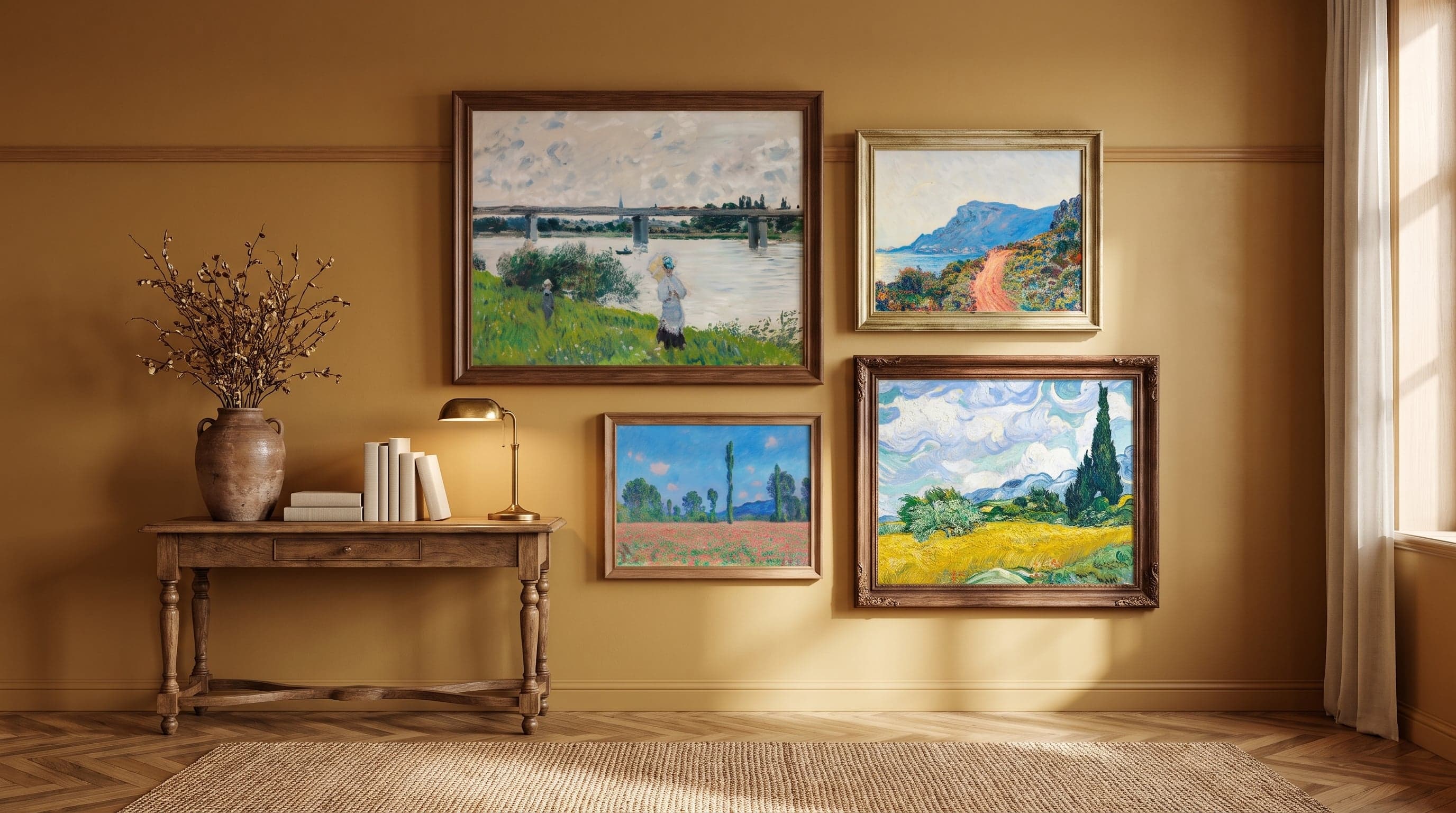
There's something about a horizon line that makes the eye pause. Perhaps it's the sense of distance, of standing somewhere and looking beyond it. The landscape has been art's most faithful subject for centuries – not because it's easy to paint, but because it's never neutral. A field, a mountain, a stretch of coastline always carries a mood, a time of day, a relationship between person and place.
Landscape art is rarely just about geography. It's about how light falls, how colour can carry emotion without a single figure appearing in the frame. From 19th-century oil paintings to today's digital illustrations, artists have used the landscape to test something larger: where the line falls between what we see and what we feel when we see it.
In this guide, we move between the classical and the contemporary – between artists who painted nature to capture an exact quality of light, and illustrators who today reduce that same nature to fields of colour and clean lines. What unites them is that the landscape never quite stops being relevant as a subject, whether it hangs as an oil painting from the 1880s or as one of today's landscape posters in the living room.
Light as Subject – The Landscapes of Impressionism
No movement changed landscape painting as radically as Impressionism. Claude Monet left the studio to paint outdoors, directly in front of his subject, with an interest that lay less in the shape of things and more in how light transformed them minute by minute. A river, a bridge, a field of poppies – the subjects were often simple, almost ordinary, but the treatment of light and atmosphere turned them into studies of impermanence. In the 1880s he travelled south to the Mediterranean coast, where the sun was sharper and the palette warmer than back home in Normandy, and painted cliffs, palm trees and coastal roads in a register of pink, orange and turquoise barely seen in French landscape painting before.
Vincent van Gogh took the same fascination with nature in another direction. His wheat fields and cypresses are never still – the brushstrokes move as if the wind itself were visible in the paint. Where Monet dissolved form into light, Van Gogh compressed the landscape into pure movement. Each, in his own way, became a starting point for how later artists would continue to simplify nature: away from exact depiction, toward emotional truth.


The Wave and the Mountain – Japanese Landscape Art
Alongside the European tradition, an entirely different visual world was taking shape in Japan – one that would profoundly influence the Impressionists. Katsushika Hokusai's woodblock prints of Mount Fuji – always present, whether in the background or at the centre of the image – show a landscape built from clear contours, flat fields of colour and rhythmic composition rather than naturalistic precision. The wave rising before the mountain in his most famous image is as much graphic form as seascape.
It's a visual logic that feels surprisingly modern. The reduction to line, contour and a handful of hues makes these works just as relevant in today's interiors as they were revolutionary when first printed. Many of the landscape posters drawing inspiration from the ukiyo-e tradition build on exactly that simplification – mountains, clouds and sea rendered as pure form rather than detailed vistas.


Lines, Fields and Planes of Colour – The Abstracted Landscape
The abstracted landscape is no new invention, but it has found renewed energy among contemporary illustrators. Where the Expressionists of the early 20th century – in movements like Der Blaue Reiter, with their paintings from Murnau – freed colour from naturalistic representation, today's artists take it a step further: terrain becomes geometry, the horizon a simple line dividing the image into two fields.
The result is nature-inspired art that communicates through colour relationships rather than fine detail. An archipelago can be reduced to deep blue against a cool grey, a field to a single curve running through warm earth tones. It's an aesthetic that speaks the same language as contemporary minimalism in interior design – calm, pared-back, yet still clearly rooted in a landscape you can recognise.


The Landscape on the Wall – A Question of Direction and Space
Unlike portraits or still lifes, a landscape often carries a clear sense of direction – a horizon that pulls the eye sideways rather than straight into the image. That makes format part of the experience. A wide, horizontal landscape can visually extend a room, while a vertical format – more common among the more abstracted interpretations – instead emphasises depth and height, like a cropped section of terrain rather than a sweeping view.
Colour palette plays the same role here as it does in painting: a landscape in cool blue-green tones creates a different dialogue with the room than one in warm ochre and rust. Anyone building a wall of several landscape posters would do well to let a shared tone – whether historical or contemporary, figurative or abstracted – tie the choices together, rather than mixing too many styles at once.
Frequently asked questions
- What counts as landscape art?
- Landscape art is a broad category spanning everything from classical oil paintings of mountains, seas and fields to contemporary, abstracted interpretations where horizon and terrain are reduced to fields of colour and simple lines.
- Why is landscape such a common subject in art?
- The landscape has long been used to explore light, space and mood without needing a human figure in the frame. That makes the subject flexible – it can be documentary, romantic, or fully abstracted depending on the artist's intent.
- Do landscape posters suit every room?
- Landscapes work in most settings since the subject itself is rarely intrusive. Format and colour palette matter more than the motif alone – a wide, light-filled landscape creates a very different feeling than a dense, dark abstracted field.
- What's the difference between classical and contemporary landscape painting?
- Classical landscape painting, as with Monet and Van Gogh, often starts from a real subject and an interest in light and atmosphere. Contemporary interpretations tend to simplify those same elements into geometric shapes and flat planes of colour.