
Sky and Horizon – Landscape in Its Simplest Form
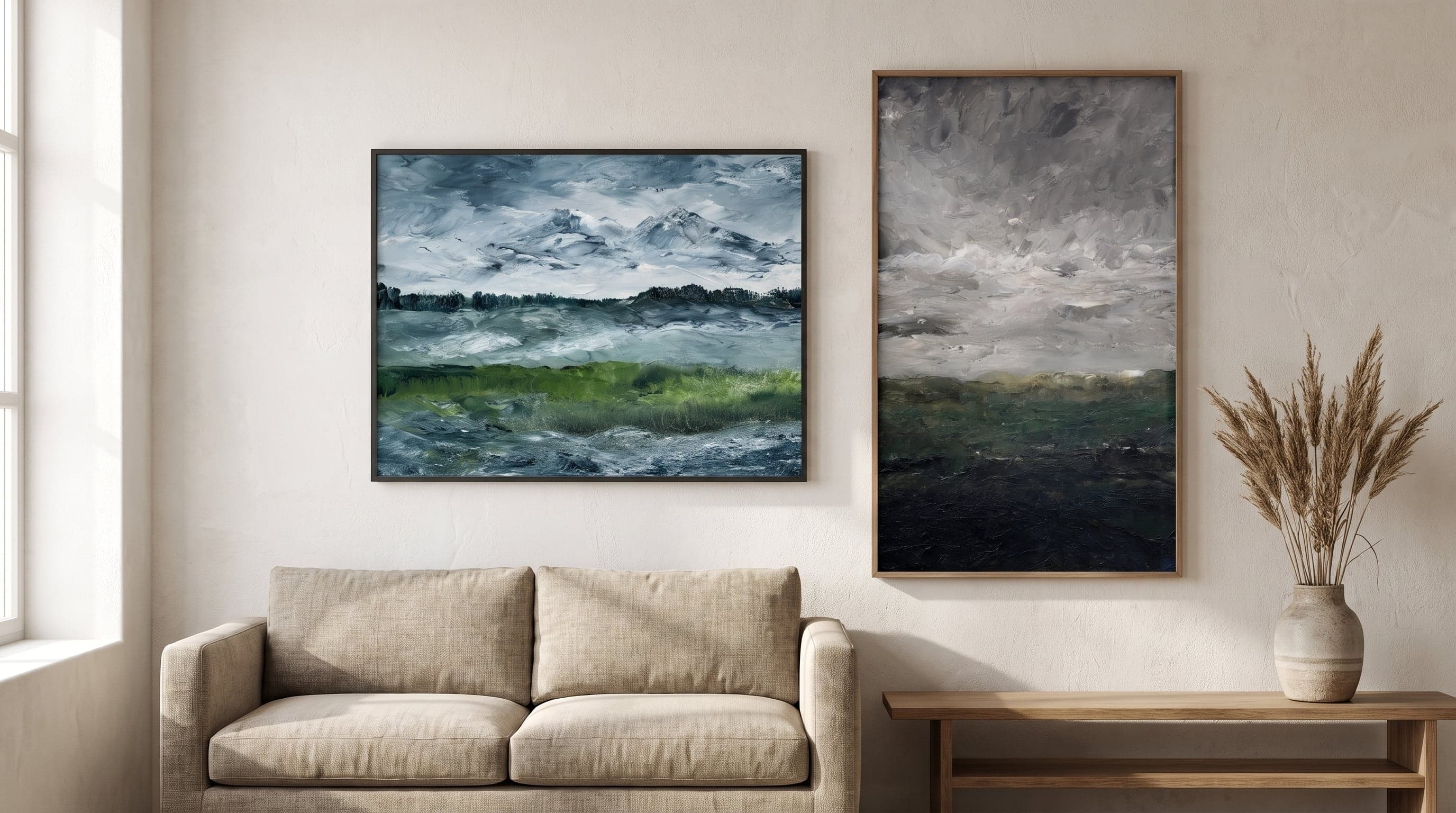
There's a moment in every landscape when detail stops mattering. The outlines of trees blur, the clouds dissolve into a single wash of grey, and all that remains is a line where sky meets land or water. That line – the horizon – has become a subject in its own right in contemporary illustration and painting, stripped away from everything that usually fills a landscape.
Minimalist landscape posters are built on that reduction. Where classical landscape painting sought to capture place, weather and light in detail, this type of image works instead with what remains once everything else is taken away. The result sits somewhere between landscape and abstraction – a borderland that has proven endlessly rewarding to look at.
The Horizon as the Backbone of Composition
In most minimalist landscapes, the horizon line isn't just one detail among many – it's the entire framework of the image. Everything else is organised around where it falls: high in the frame to give weight to the ground, low to let the sky dominate. That simplicity is demanding. With no trees, houses or figures to lean on, the placement of the line, the temperature of the colour, and the texture of the surface have to carry the whole experience on their own.
Many of the studies that circulate in contemporary art trace their roots to the early 1900s, when landscape painting had already begun shifting away from the descriptive and toward the atmospheric. It's no coincidence that these images feel both historic and thoroughly contemporary – they were wrestling with the same question that today's minimalism asks: how little needs to be shown for nature to feel present? It's a question tied to the whole field of landscape art, where nature is constantly being renegotiated as subject matter.


Colour Fields as Weather
Once the outlines disappear, colour takes over the job of conveying light and season. A muted ochre field reads instantly as late autumn; a pale blue-grey as dawn over water. It's a shift from form to mood – the landscape becomes less a place and more a state of being.
This kind of work sits close to what is sometimes called colour field painting, though without its complete detachment from subject matter. There's still a ground and a sky to sense, only faintly suggested by where the colours meet. The same reduction of form into light and mood can be traced in depictions of the sea, the horizon and the light, where water often becomes just as quiet a protagonist as the sky does here. The effect is, paradoxically, more atmospheric than many detail-rich landscapes – the viewer is left to fill in the rest.


The Legacy of Landscape Painting
It's hard to talk about reduced landscapes without mentioning the Impressionists, who were already dissolving form into light and brushstroke back in the 1870s. Monet's studies of dawn and mist are, in practice, early exercises in exactly what we now call minimalism – the same drive to capture the atmosphere of a moment rather than every individual detail of a scene.
The line running from 19th-century plein-air painting to today's pared-back poster art is more direct than one might think. The difference lies more in medium and context than in ambition: both are trying to convey what it feels like to stand before a landscape, not merely what it looks like. A similar dissolving of form can be sensed in how the forest as visual language is built from density, shadow and stillness rather than individual trees.


Neutral Tones and the Starkest Palette
Another strand within minimalist landscape art works almost entirely without colour in the conventional sense – just shades of sand, grey and bone white, laid down in loose, watercolour-like layers. This is landscape stripped down to texture rather than subject: the surface becomes more important than what it depicts.
This palette has become especially popular in interiors with Japandi influences, where calm and material quality carry more weight than clear figuration. The same pursuit of broad, serene lines reappears in depictions of mountains and vast landscapes, where the sheer scale of the terrain becomes the defining expression. It isn't that the landscape disappears, but that it whispers rather than speaks.


Why This Restraint Resonates Now
It's tempting to dismiss minimalism as just a passing trend, but the interest in reduced landscapes says something bigger about how we relate to images in general. In a feed full of information and detail, the simple motif becomes a pause – nothing to analyse in depth, just a surface for the eye to rest on.
Yet that restraint isn't empty. A landscape reduced to line and colour field actually demands more of the viewer, not less: you have to imagine for yourself the wind, the cold, the light that isn't shown. That's perhaps exactly why this kind of image feels so relevant now – it asks us to slow down and fill in what's missing, at a time when most things have already been spelled out for us.
Frequently asked questions
- What characterises a minimalist landscape poster?
- Typically a strong horizon line, a limited colour palette, and the absence of details like trees, buildings or figures. The focus is on light, space and mood rather than a specific subject.
- How do minimalist landscapes differ from abstract art?
- They sit close together, but a minimalist landscape usually retains a hint of place – ground, sky or water – while pure abstraction can lack any connection to a concrete subject at all.
- Does this style work alongside other nature motifs on the same wall?
- Yes, pared-back landscapes often serve as a calm counterpoint to more detailed nature or cityscape motifs, since the colour fields give the eye somewhere to rest between busier images.
- What paper are posters printed on at Care of Posters?
- All art prints are produced using 12-colour giclée printing on FSC-certified Fine Art paper, 200 gsm, with a smooth matte surface that doesn't reflect light.