
The Nude Study – the Body as an Artistic Subject
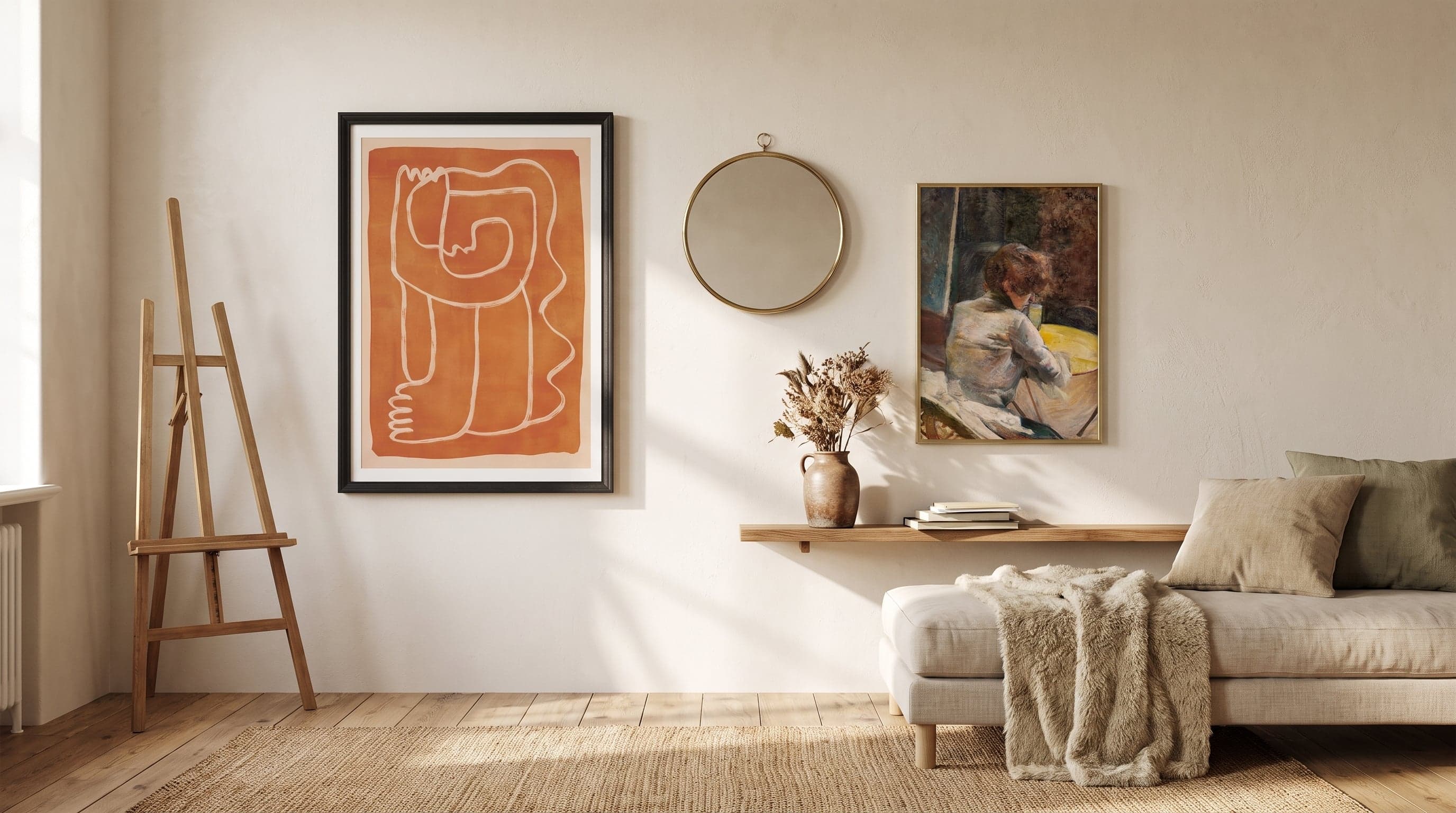
Before an art student finds their own voice, they often first encounter the body. The naked, unembellished body, placed before a room full of sketching eyes. It's an exercise that has been repeated in European art academies for centuries – not to shock, but because the body is the most demanding subject there is. Proportions, light, weight, the tension in a muscle holding up a pose. Everything must be negotiated on paper, again and again, until the hand learns to see what the eye already knows.
The nude study as art is therefore rarely just a subject. It's a method, a way of training the eye before interpretation is allowed to take over. But the method has also become an artistic language in its own right – one that today reaches far beyond charcoal and white paper, into vivid brushstrokes, abstracted forms and silhouettes that barely resemble bodies anymore. At its core, it grapples with the same question as all figurative art: how does a human being become an image?
The Academy's Gaze – Croquis and the Classical Nude Study
The classical nude study, croquis, originates in the academy drawing halls, where live models posed for hours so students could practise the body's anatomy and centre of gravity. It was – and still is, at many art schools – a discipline rather than an artwork in itself. The line must find the form before it has time to become aesthetics. Just as the portrait as a genre forces a concentrated gaze on the face, the nude study forces an equally disciplined gaze on the entire body.
It's no coincidence that the sculptor Auguste Rodin keeps returning in this context. His drawings, often quick and almost unfinished on the surface, show how a three-dimensional understanding of the body can be translated into just a few lines on paper. The earthy, beige and apricot tones in these studies echo skin's own palette – a choice that makes the subject timeless rather than nostalgic.


The Line as Notation – the Body in Quick Strokes
Before colour and composition take over, the nude study is about the line as notation – a quick record of a movement, a weight, a direction. The artist often works against the clock, forcing an economy into the strokes. What remains is the essential: the line of a back, the angle of a shoulder, the contour of a knee.
This reduction has a beauty of its own, and it reaches further back than one might think. Late 19th-century studies of the body in everyday, unguarded poses – someone waiting, someone turning their back – show that the nude study was never only about the idealised. Just as often, it has sought the effortless, the almost documentary.


Colour Takes Over – the Nude Study in Painting
At some point, the grip of the academic answer key loosens. The body stops being merely an anatomical problem to solve and instead becomes a surface for colour, movement and feeling. The brush is allowed to show, the acrylic paint is allowed to drip, and the proportions no longer need to be millimetre-accurate for the subject to feel true.
This is the nude study liberated from its pedagogical mission – paintings where the body lies in bed or stands in the room without apologising for its presence. The colour palette often turns warm and saturated, sometimes almost expressive, a way of painting feeling rather than form. The same liberation can be traced in how female portraits in art have shifted over time from idealised stillness to a freer, more subjective visual language.


The Body as Abstraction in Contemporary Art
Another path leads away from the figure entirely, or almost. The body is broken down into geometric fields, colour blocks and incomplete contours, until the viewer themselves must fill in where a shoulder or a thigh actually is. It's an abstraction that nevertheless retains something bodily in its rhythm – a curve, a centre of gravity, a hint of skin.
This direction says something about how the nude study relates to contemporary painting as a whole: the subject may be ancient, but the language used to depict it is constantly renewed. Here, the academic tradition meets a freer, more exploratory visual language, where the body becomes a starting point rather than an end goal.


The Body in Motion – the Athlete and the Dancer as Subject
The nude study's fascination with the body's mechanics lives on in depictions of the athlete and the dancer – bodies captured mid-exertion, in a moment of balance that will soon end. It's the same anatomical curiosity found in the academy drawing halls, but moved into a different setting: the competition arena, the stage, movement itself.
Historically, the idealised, athletic body has been just as central to art as the seated model – from classical sculpture to early 20th-century depictions of track and field athletes. Today's interpretations retain that dynamism, but in a visual language that is often more abstracted and colour-conscious than its predecessors.


Frequently asked questions
- What is a nude study in an art context?
- A nude study is an artwork – often a drawing or painting – in which the naked body is the main subject. Originally an exercise in art education, used to train understanding of anatomy, proportion and light.
- Why does the nude study hold such a central place in art education?
- The body is one of the most demanding subjects to render accurately, since it moves, carries weight, and offers no straight lines to rely on. Practising it trains the eye for form, volume and light in a way few other subjects do.
- How do today's nude studies differ from the classical ones?
- While classical studies often kept to charcoal, graphite or sanguine and a strict anatomical focus, contemporary interpretations allow themselves more freedom – in colour, brushwork and degree of abstraction. The subject remains the same, but the language has opened up.