
Women's Portraits in Art – A Tradition in Constant Reinterpretation
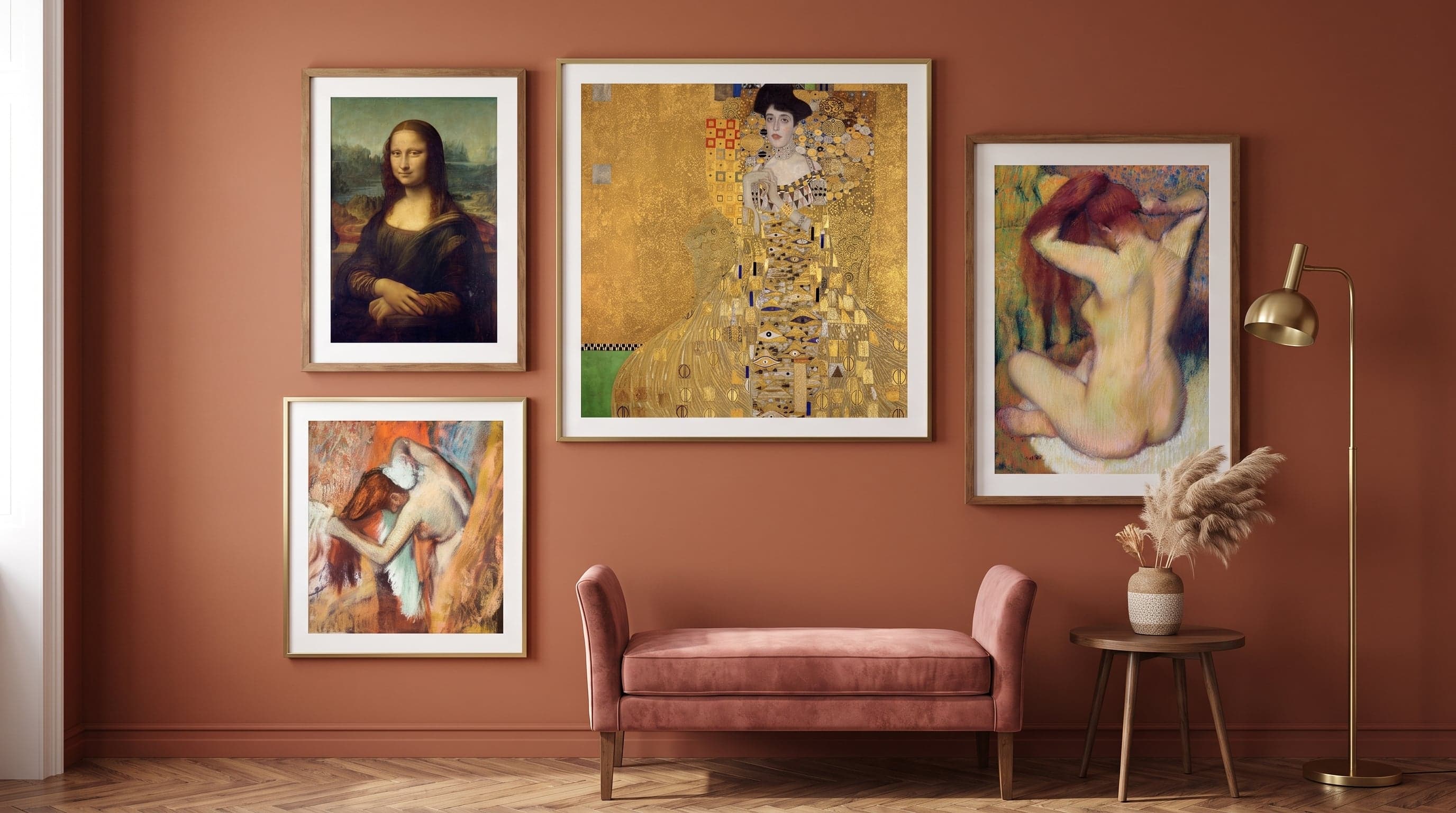
Few subjects have been painted, photographed and reproduced as often as the woman. Yet the image keeps shifting – the same face, the same body, but a different gaze behind the brush each time. The Mona Lisa's smile has been interpreted for five hundred years without anyone quite agreeing on what it means, and that very uncertainty says something about the whole genre: the portrait of a woman has rarely been just about the person depicted, but about who's looking, and why.
From the stylised society portraits of the Renaissance, through the intimate interiors of the turn of the century, to the abstract, feminist-inflected depictions of our own time, women's portraits in art trace how each era has viewed the body, power and identity. It's art history in miniature, condensed into a single face.
The Gaze That Shaped Her – Early Women's Portraits in Art
Early portraits of women were rarely made for the woman herself. They were commissioned by men – husbands, fathers, patrons – and painted to display status, beauty and virtue in just the right proportions. Leonardo da Vinci's attention to light and anatomy turned the Mona Lisa into something more than a mere commission, but the basic premise remained the same as for most portraits of the time: the woman was the subject, not the author. It's a dynamic that recurs throughout much of figurative art across history.
Vienna at the turn of the century shifted the perspective without fully breaking it. Gustav Klimt's gilded portraits of women, such as the one of Adele Bloch-Bauer, made the woman as much an ornament as a person – pattern, gold, and pattern again, until the face nearly dissolves into the background. It's decorative and psychological at once, a tension that still makes these works compelling to hang.


The Dressing Table and the Private Room – Intimate Women's Portraits
In the late 1800s, the portrait of the woman moved into the bedroom. Degas and his contemporaries painted women combing their hair, washing, absorbed in their own routines – scenes that gave the impression of being unobserved. But the model was rarely truly unobserved; the artist's gaze was always there, and the question of who is really watching whom has followed these images ever since. The same tension between model and viewer runs through the portrait as a genre, whether in oil or photograph.
What makes these motifs interesting today is precisely that duality. From one angle, it's intimate, almost documentary, everyday life. From another, it's still someone looking at a woman who doesn't know it – or pretends not to. That ambivalence makes the portraits feel more complex the longer you study them, rather than less.


From Model to Subject – The Turning Point in Women's Portraiture
The shift from passive model to active subject didn't happen at any single point in time, but crept in through how artists began painting gazes that look back. Munch's portraits of women, with their heavy symbolism and faces charged with emotion rather than idealised beauty, mark a clear turning point. The woman stops being a still life of flesh and fabric and becomes someone with an inner world pressing outward.
At the same time, new compositions emerge – women seen from behind, waiting, in motion rather than pose. These are small shifts, but they fundamentally change the relationship between viewer and subject. Suddenly, it's no longer a given that we get to see everything.
Contemporary Reinterpretations of the Woman's Portrait
In today's art prints, the woman's portrait is rarely a likeness in the traditional sense. Just as often, it's a concept – body and identity processed through collage, abstraction and graphic language. Where 19th-century portraits sought recognisability, many contemporary works seek the opposite: dissolution, layering, fields of colour that conceal as much as they reveal.
This ties into a broader movement within the human figure as subject right now, where female representation is used to raise questions rather than provide answers. Is this a specific woman, or femininity as a phenomenon? Many of these new works want to keep that open, leaving the viewer with the task of filling in the face themselves.


Fragment, Form and New Expression in Modern Women's Portraits
Some of the most interesting contemporary women's portraits deliberately break with wholeness. Silhouettes, double exposures, geometric fields that merely suggest a body – these approaches strip the classic, fully-resolved image of woman of its edge and replace it with something more fluid. Form becomes as important as subject.
At the same time, pop art freely borrows from icons that are already over-interpreted, twisting them another turn still. Marilyn Monroe has been repainted so many times that she barely represents a person anymore – more a sign for gaze, celebrity and femininity as a state of being. It's a different kind of reinterpretation than Munch's or Klimt's, but it belongs to the same long conversation about the evolution of the portrait genre.
Regardless of direction, most of these works are printed with twelve-colour giclée on age-resistant Fine Art paper, ensuring that even the most nuanced colour transitions in an abstract portrait keep their lustre over time.


Frequently asked questions
- What characterises a classic woman's portrait in art history?
- Often a clear pose, idealised features and a composition that emphasises status or virtue rather than the subject's inner life. It's the artist's and patron's gaze that governs the image, not the subject's own.
- How do contemporary women's portraits differ from older traditions?
- Contemporary works more often engage with abstraction, fragmentation and concept than with an exact likeness. The focus lies on identity and emotion rather than accurately rendering a specific face.
- Can historical and modern women's portraits be mixed on the same wall?
- Yes. A shared colour palette or similar visual language often ties a mix together better than having all works from the same period. A gold-toned Klimt-style portrait and a graphic abstract portrait can work beautifully together if the palette matches.
- What sizes work best for a portrait as a focal piece?
- It depends on the wall, but posters are available from 21x30 up to 70x100 cm, with or without a white border, making it possible to adapt the piece as a standalone eye-catcher or as part of a collection.