
Portraiture as a Genre – From Oil Painting to Poster
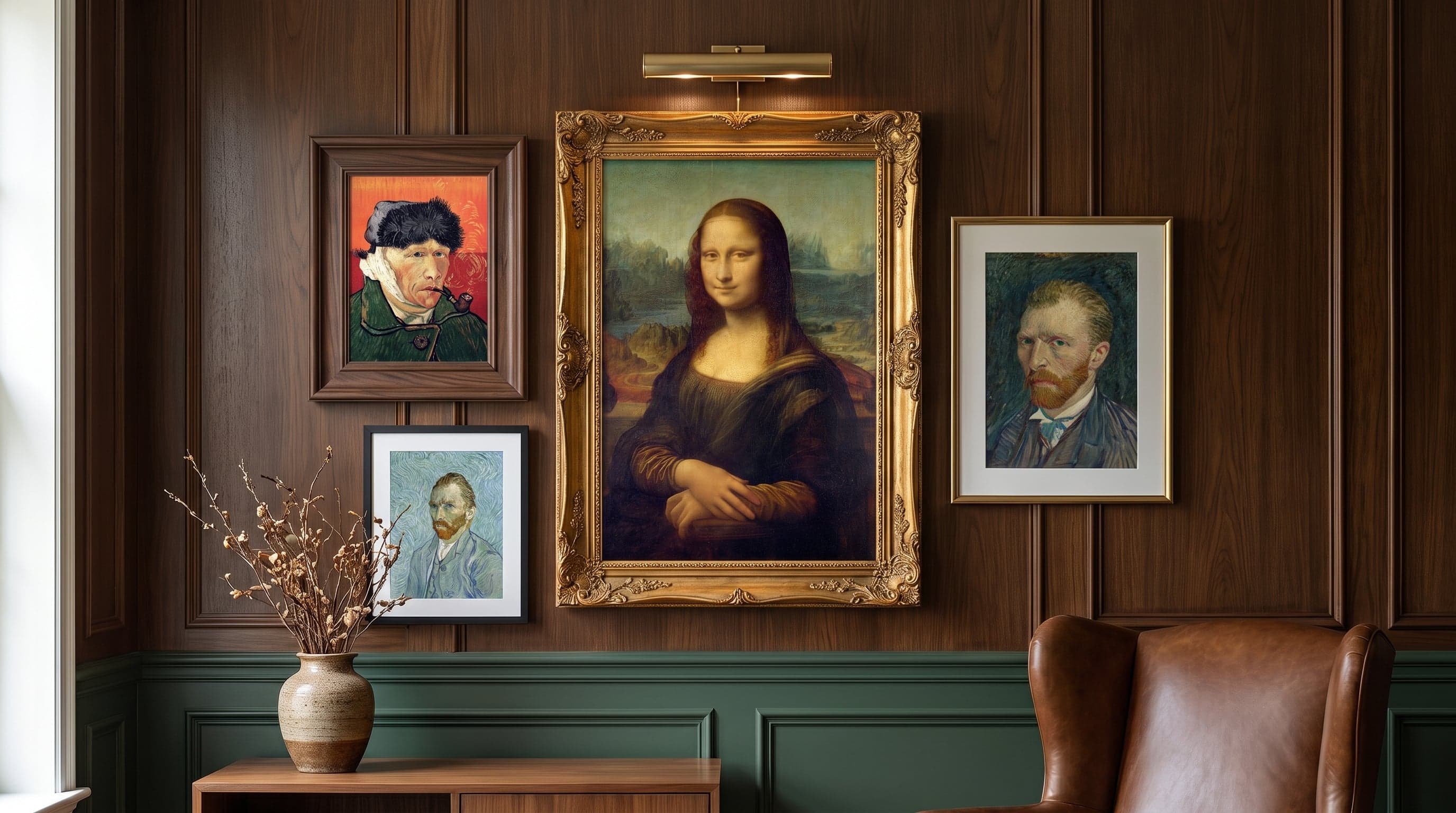
There's something unresolved about a painted face. A photograph captures a moment, but a hand-painted portrait is the result of hours of staring, of an artist trying to reach something beyond the surface features. Maybe that's why the genre refuses to die out, even though it should long ago have been overtaken by the camera, and later by the screen.
Portraiture has always been about more than likeness. It's about who gets to be seen, how, and what the viewer is expected to feel in front of someone staring back. From court paintings commissioned to cement power to today's fragmented, abstracted faces in graphic art – the portrait is one of the oldest branches of figurative art, where the human being itself becomes the subject, and it tells us as much about its own era as about its subject.
As portrait posters, the old masterworks have been given new life on modern walls, side by side with contemporary interpretations that break the face apart into fields of colour and line. It's that shift – from stylised ideal to personal, sometimes raw, interpretation – that makes the genre worth following right now.
The Stylised Faces of the Renaissance
Leonardo da Vinci's Mona Lisa has been looked at so much that it's hard to see it with fresh eyes, but that's exactly what makes it worth returning to. The painting is famous for its smile that never quite settles – a face that refuses to give the viewer a clear answer. That was novel for its time: portraits were supposed to be idealised, not ambiguous.
The same artist painted Lady With an Ermine, a portrait where the gaze is just as enigmatic but the posture more dynamic – the head turned, the animal in her arms alive rather than merely symbolic. Both works show a Renaissance painter experimenting with what a face could communicate without smiling, without speaking, through direction and light alone – an early version of what would later grow into a broader tradition of art where the human figure is the main subject.


Van Gogh and the Persistence of the Self-Portrait
Few artists have examined their own face as systematically as Vincent van Gogh. Over just a few years, he painted an estimated thirty-odd self-portraits, often because he couldn't afford to pay models. The result became something other than necessity – a series of studies in how one and the same face can look completely different depending on light, brushwork and mood.
The self-portrait with the bandaged ear is the most famous, charged with a story that's hard to separate from the image. But it's in the less dramatic versions – the stubble, the pipe, the blue background vibrating with short strokes – that you see his real obsession: painting himself until the face became a landscape of colour rather than a likeness.


Turn-of-the-Century Vienna: A New Way of Seeing the Face
In Vienna around the turn of the century 1900, artists like Gustav Klimt broke the portrait tradition apart from within. The face kept its realism, but everything around it – clothing, background, hair – dissolved into ornament and gold. The portrait of Helene Klimt shows that tension clearly: a quiet, almost shy face surrounded by patterns that nearly take over the image.
It was also a turning point in how women were portrayed. A work like Porträt Einer Dame balances between comfortable bourgeois fashion and an artistic language moving towards something more abstract, while the portrait of Inga Maria Thiel shows how line itself – sharp, almost graphic – began competing with colour to carry the expression.


Faces of Poster Art – From Lautrec to Pop
Henri de Toulouse-Lautrec moved the portrait from the salon to the street. His lithograph of the dancer and performer May Milton is a portrait shaped by the demands of poster art: quickly readable, bold in outline, built to catch a glance in passing rather than hold it for hours. It's still a portrait, but with an entirely different pulse than the Renaissance's quiet studies.
That logic lives on in later reinterpretations of famous faces – Marilyn Monroe keeps returning as a subject, as much icon as individual, while works like Girl With Pearl – the Undead Edition show how contemporary artists have no qualms about twisting classic portraits into something darker and more playful. The genre has never been sacred.


Portraits Today: Dissolved, Abstracted, Personal
Contemporary portrait art is rarely after likeness. The face remains as a structure, but is often fragmented into fields of colour, rough brushstrokes or geometric shapes – as if the artist trusts that the viewer will still recognise the human, even once the details are gone. It's a movement that feels related to how we relate to identity today: less fixed, more fluid – a further development of the entire figurative tradition of depicting the human being.
Works like Modern Abstract Woman 4 and Abstract Face Portrait work with exactly that tension between recognition and dissolution, while Minimal Art Girl and Girl In Red No.2 show two different routes to the same goal – one stripped down to a handful of lines, the other saturated in colour and pattern. The portrait simply keeps finding new ways to ask the same old question: what is a face, really, once you take everything else away?


Frequently asked questions
- What counts as a portrait poster?
- A portrait poster depicts a person, real or fictional, with the face or upper body as the focus. It can be a classic oil painting in a new format or a contemporary, more abstracted interpretation of a face.
- Why have classic portraits like the Mona Lisa become popular as posters?
- Classic portraits carry recognition and art-historical weight, while in a modern format without the original's frame, they can feel surprisingly contemporary on a wall.
- Do abstract portraits and classic portraits work together on the same wall?
- Yes – the contrast between stylised realism and dissolved, graphic interpretation is often exactly what makes a collection of portraits interesting rather than monotonous.