
Minimalism as an Art Concept – When Less Became a Language
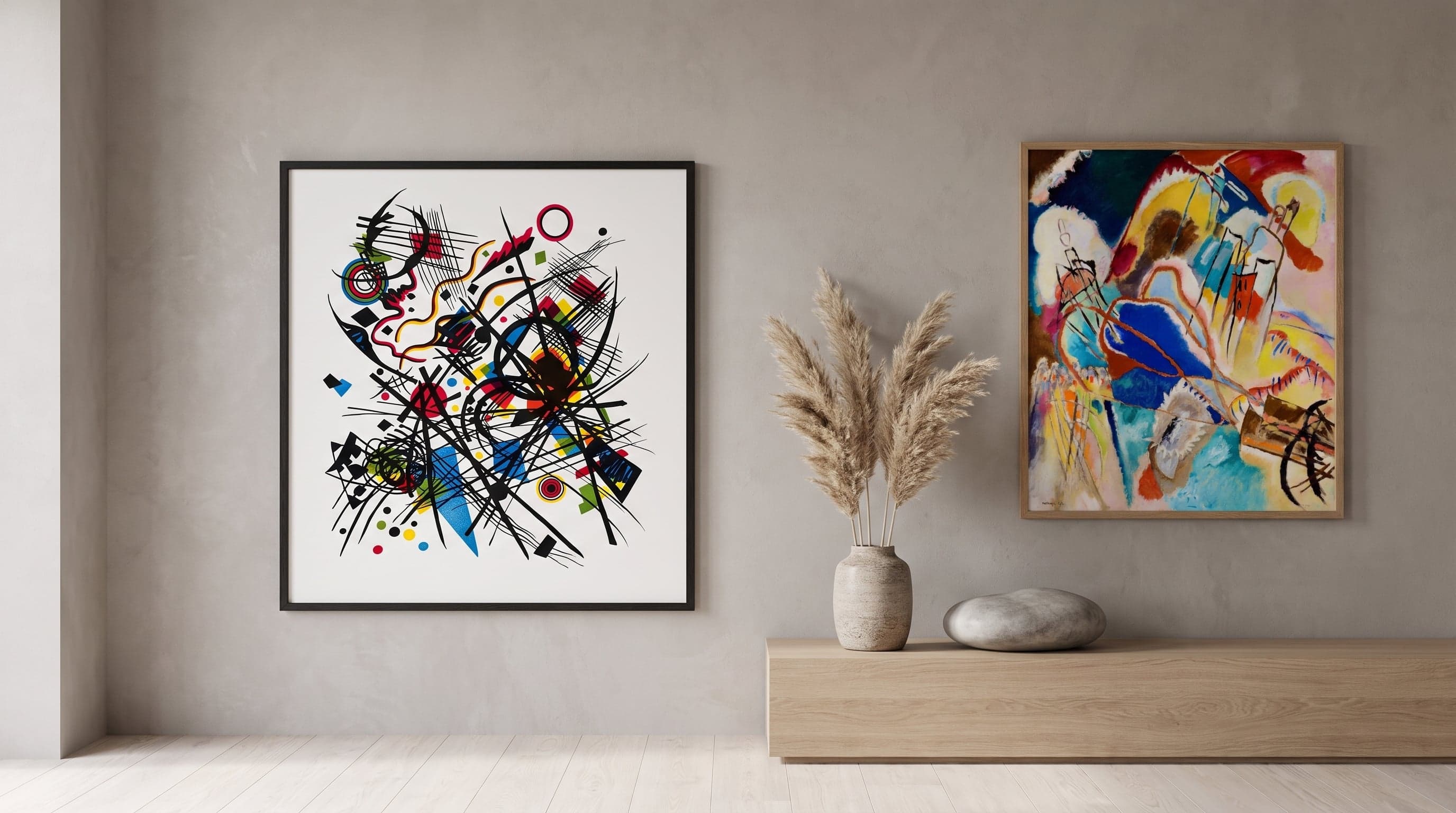
It's easy to assume that minimalism in art is simply about taking things away. But the artists who first articulated the idea weren't after emptiness – they were after what remains once everything inessential has been stripped away. A line. A shape. A field of pure colour that doesn't explain itself but simply exists, unshakeable.
That story doesn't begin in a Scandinavian living room but in early-20th-century Europe, at a time when painting, following Impressionism's revolt against academic painting, had just left representation behind and faced a question with no obvious answer: if art no longer needs to depict the world, what should it do instead? For several of the century's most important artists, the answer was reduction – not as a style, but as an inquiry.
It's this idea, rather than the pristine white room, that makes minimalism worth returning to in an age when the eye rarely gets to rest. To understand what makes it so singular and so enduring, it's worth viewing it alongside art's various eras and their differing approaches to what is essential.
Bauhaus and the Art of Stripping Back
When the Bauhaus was founded in Weimar in 1919, the ambition was never to make art bare. The school sought a visual language that could speak to everyone – beyond nationality, class and taste – and found it in geometry. The circle, the triangle, the square: shapes that needed no translation to be understood. Reduction became a way of reaching the universal, not a way of simplifying for simplicity's sake.
Where Art Nouveau's sweeping curves had, a generation earlier, sought beauty in the forms of nature, the Bauhaus turned toward straight lines and pure basic shapes – a clear break from the ornamental tradition that preceded it. The school's teachers, from Kandinsky to Klee and Moholy-Nagy, spread their ideas partly through print portfolios – collections that made the experimental accessible beyond the studio. It's a way of thinking that can still be traced in how geometric abstraction is handled today: as an attempt to find structure in something that might otherwise tip into chaos.


Kandinsky's Path Toward the Essential
No artist illustrates the movement toward reduction more clearly than Kandinsky himself. In his early Improvisations, painted in Munich in the years before the First World War, the abstraction is still gestural – brushstrokes moving like music, colour spilling without settling. At that point he was working close to the emotional visual language of German Expressionism, where the brushstroke carried as much meaning as the subject itself.
When he later joined the Bauhaus, his visual language changed fundamentally. The forms tighten, the brushstroke disappears, and what remains are pure geometric relationships – circles balanced against lines, fields of colour weighed against one another with almost mathematical precision. This shift within a single artist's career mirrors the movement of the entire era: from expression to structure, from feeling to thought.


The Silent Grammar of Geometry
What was once a philosophical project has, over time, become a visual language in its own right, detached from its original ideas yet still dependent on the same grammar: shape, colour field, negative space. Contemporary geometric abstraction borrows freely from that logic – but rarely seeks any universal truth. Here, reduction is more about visual calm, a counterweight to images that otherwise compete for attention.
That's what allows works built on pure forms and pared-back compositions to feel both historically rooted and entirely contemporary at once. The grammar is over a hundred years old. What's said with it keeps changing.


Minimalism's Contemporary Voices
Today, reduction often returns in a softer register. Where the early geometric pioneers worked with sharp outlines and pure primary colours, many contemporary works move toward muted, earthy palettes – sand, grey, a broken white. Shapes overlap rather than separate, and the surface is allowed to be uneven, almost tactile.
It remains an art of omission, but with a more exploratory, less programmatic relationship to what is left behind. Perhaps it's precisely that distinction – between reduction as manifesto and reduction as mood – that keeps minimalism from ever becoming a closed chapter.


Why the Sparse Appeals in a Saturated Age
It's hard not to see a connection between minimalism's resurgence and the visual saturation most of us live with. Feeds, screens, a constant hum of information – in that landscape, a single shape on an empty surface becomes almost an act of resistance. Not as escapism, but as another way of seeing: slower, more focused, giving the eye room to linger a little longer than usual.
That likely explains part of why the pared-back visual language keeps attracting attention, far beyond its original context. Reduction doesn't offer less to look at – it offers a different pace for looking.
Frequently asked questions
- What is meant by minimalism in art?
- Minimalism in art refers to a visual language and a tradition of ideas in which a work's expression is concentrated into necessary elements – form, colour, surface and space – rather than detail or representational subject matter. It's about reduction as a method for reaching something essential, not simplicity for its own sake.
- How are minimalism and the Bauhaus connected?
- The Bauhaus was one of the schools that formalised the idea of geometric reduction as a universal visual language. Teachers such as Kandinsky and Klee explored how simple forms could carry meaning beyond cultural and national boundaries, laying the groundwork for much of the thinking later described as minimalist.
- Is minimalist art the same thing as abstract art?
- Not necessarily. All minimalist art is abstract, but not all abstract art is minimalist. Abstraction can be gestural, chaotic or richly detailed, whereas minimalism specifically aims to reduce a work's content to a handful of shapes or colour fields.