
Impressionism – The Light That Became a Painting
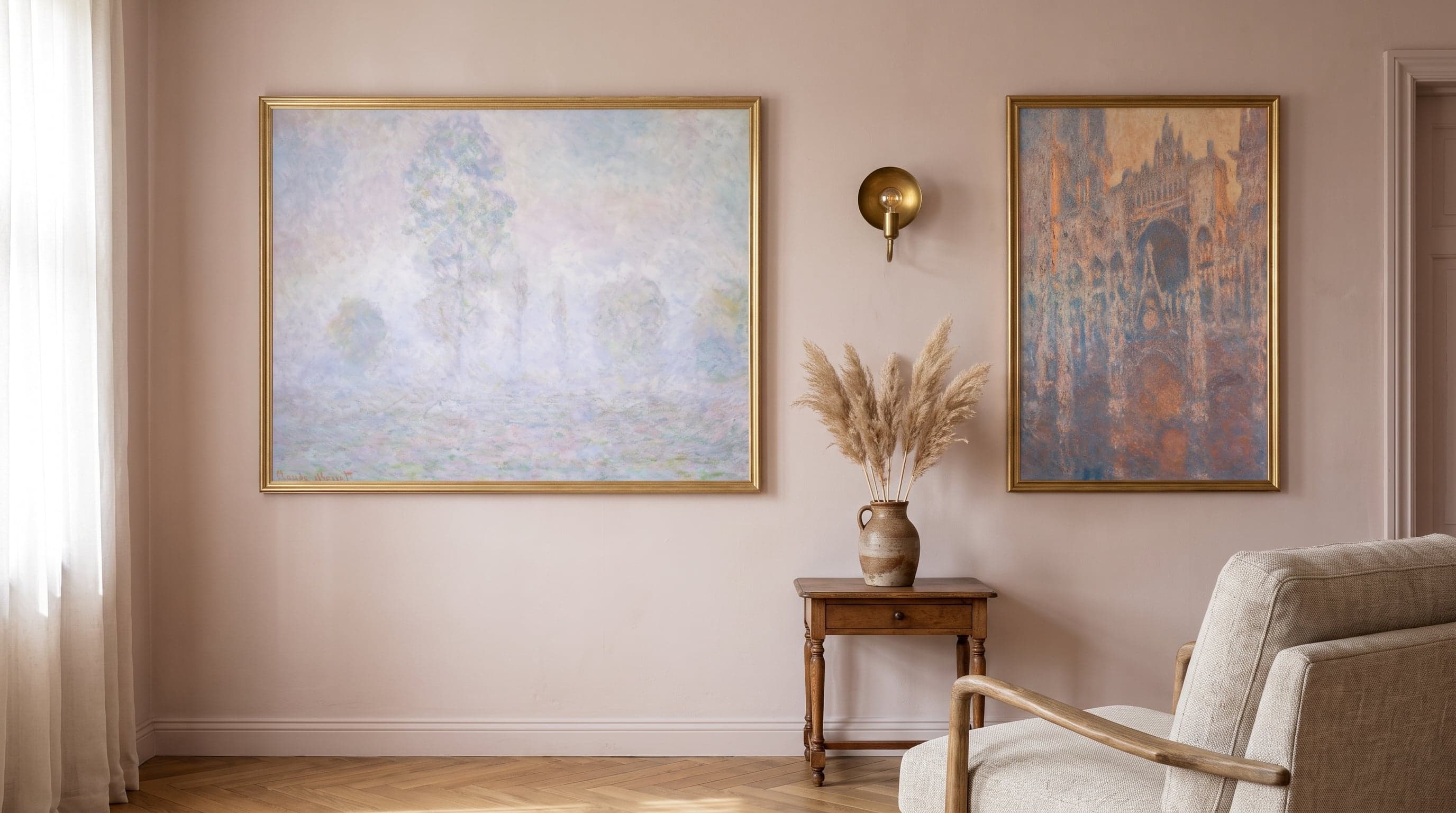
Picture an afternoon in Paris sometime in the 1870s, where academy-trained artists were still expected to paint with crisp outlines and a story worth telling. Then along comes a group of painters who couldn't care less. They set up their easels outdoors, worked fast before the light could shift, and left their brushstrokes visible instead of smoothing them away. Critics called it unfinished, even sloppy. One of them coined the word impressionism as an insult, after a painting by Claude Monet titled Impression, Sunrise.
What made the picture so hard to swallow in 1874 is exactly what makes it so easy to live with today: a style of painting built on sensation rather than description. The Impressionists stopped asking what was in front of them and started asking what it looked like right now – in that light, that humidity, that wind-blown minute. Outline dissolved so light could take centre stage. To understand impressionism's characteristics in a wider context, it helps to first step back and see where the movement fits within the broader history of art.
It's that looseness that still feels surprisingly contemporary on a wall today. An Impressionist scene rarely tells a story you need to decode. It offers a mood, a weather, a time of day – and leaves the rest open.
Light, Not Line – Impressionism's Clearest Trait
The clearest hallmark of impressionism is the absence of a fixed outline. Where academic art built form through layered line and shadow, the Impressionists painted alla prima – wet paint into wet paint, in a single extended session before the subject could change. The result is surfaces that seem to vibrate rather than sit still: water glittering in short, broken strokes, skies that are patchy pink and grey at once.
Monet's Impression, Sunrise from 1872 is often where the story begins, precisely because it shows so clearly what was lost and gained in the same stroke. The sun is barely more than an orange smudge, the boats suggested rather than described, and yet the eye instantly reads dawn breaking over a misty harbour. This is painting that trusts the viewer's gaze to fill in what the brush only hints at.


Same Subject, Different Hours: The Role of Series Painting in Impressionism
Another hallmark, perhaps the most disciplined in the whole movement, is series painting. Monet returned to the same cathedral façade, the same haystack, again and again – not for lack of ideas, but because he wanted to show how light alone could turn one and the same subject into an entirely new painting. Rouen Cathedral was painted at dawn, in midday heat, in hazy winter light, until the stone almost dissolved into pure colour.
The haystacks outside Giverny served the same purpose: simple, stable shapes that became a neutral surface onto which weather and season could be projected. Snow, ice, golden light, blue shadow – the subject itself is essentially secondary. What's actually being painted is the time of day.


Giverny – The Garden That Became a Studio
Toward the end of his life, Monet effectively moved into his own subject matter. His garden at Giverny, with its constructed pond and Japanese bridge, became a place he no longer had to travel to paint – he could simply step outside. The water lilies covering the pond's surface across dozens of canvases are perhaps the clearest evidence of where impressionism was ultimately heading: away from the horizon, away from perspective, and down into the water's surface itself, where sky, leaf and reflection merge into almost pure colour structure.
The Japanese bridge, painted in green and lilac haze, is a scene without depth in any conventional sense. You don't step into the picture, you sink into it. This is where impressionism starts to resemble what would later become abstract painting – without ever abandoning the subject it loved most.


Water, Ice and Mist: Weather as the Main Subject
Weather was never mere backdrop for the Impressionists – it was the subject itself. Monet travelled to London to paint the Houses of Parliament wrapped in the dense industrial fog the city was famous for, a subject that would hardly work without that exact atmosphere. The façade appears only as a dark silhouette behind layers of yellow and purple, a building dissolved by air.
The same fascination with weather as protagonist recurs in his studies of ice-bound rivers and rocky coastlines: cold, blue winters where sunlight reflects off ice, or sea cliffs where the light changes the colour of the rock minute by minute. These are subjects hard to imagine in crisp, academic outline – they require the loose brush simply to function at all.


Why Impressionist Style Still Feels Modern
It's easy to forget how radical this was, seeing it today framed and calm in a gallery or on a living room wall. But that loose, atmospheric brushwork was a protest against an entire institution that demanded skill measured in precision. The Impressionists proposed something else: that a sense of light could be just as true as an exactly rendered form. Anyone wanting to place this turning point alongside other breaks in the history of painting will find a broader map in our guide to art movements.
That idea has aged remarkably well. In an age full of sharp screens and high-resolution images, there's something restful about painting that deliberately blurs the detail and instead invites the eye to rest in colour and mood. Impressionist art asks for no answer key. It simply asks for a moment of attention – roughly the same moment the painter himself had, before the light could change.
Frequently asked questions
- What characterises impressionism?
- Loose, visible brushwork, a fascination with light and weather rather than exact form, and paintings made quickly, often outdoors, to capture a fleeting moment rather than a detailed description of the subject.
- What is impressionism, in short?
- An art movement that emerged in France during the 1870s, breaking with the academy's demand for crisp outlines and historical subject matter in favour of studies of light, atmosphere and the momentary impression.
- Why is Claude Monet so central to impressionism?
- Monet pushed the idea of light as the true subject further than anyone else, notably through his series of the same motif painted in different light and weather, and through the late water lily paintings that approach pure colour structure.
- Does impressionist art differ much from earlier painting?
- Yes. Earlier painting built form through line, shadow and detailed, layered construction. The Impressionists often painted in a single session, with visible brushstrokes and without finishing every detail.