
Expressionism – When Feeling Became Form
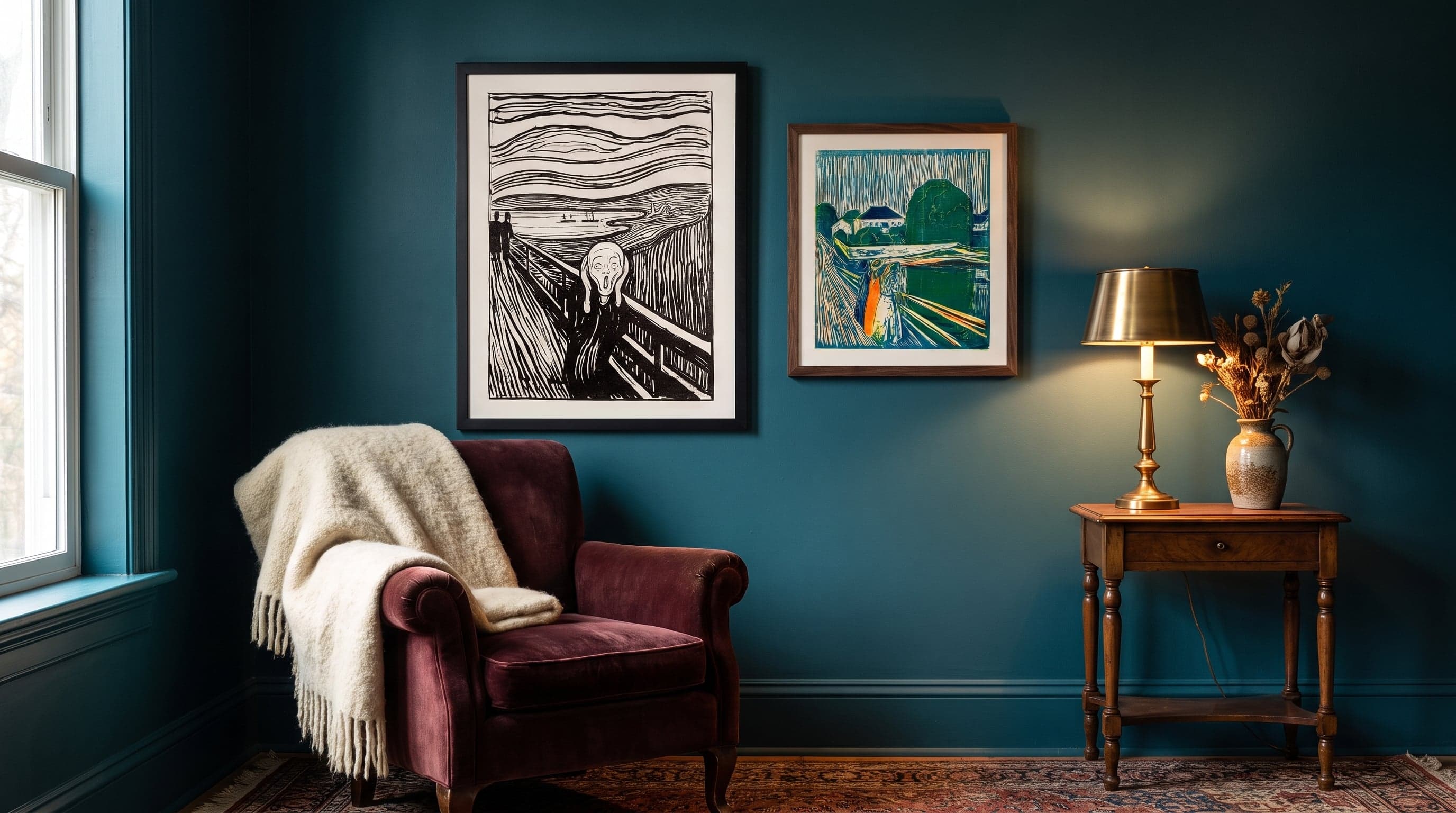
Around the turn of the 20th century, something shifted in painting. Artists stopped asking how light fell across a French garden and started asking how it felt to be human in a city growing too fast, in a society shaking at its joints. Lines bent. Colour tore itself free from its subject and began to live a wild, toxic life of its own. It was no longer the eye guiding the brush – it was the nerves.
Expressionism emerged as a reaction against Impressionism's quiet observation of light and atmosphere. Where the Impressionists sought to capture a moment from the outside, the Expressionists wanted to push something out from within – anxiety, longing, excitement, grief. The result was a visual language that still feels raw and uncomfortable more than a century later.
No one has come to represent this expression as clearly as Edvard Munch, but Expressionism was never the project of a single artist. It spread across Germany, Austria and France in various guises – from Fauvism's poisonous green skin tones to Der Blaue Reiter's mystical abstraction – and it still lives on, clearly, in contemporary figurative painting. Exploring expressionist art really means understanding how a feeling becomes line and colour, long before it becomes a subject.
What defines Expressionism?
Ask ten art historians what defines Expressionism and you'll get ten slightly different answers, but a few traits keep recurring. Form is distorted – bodies stretch, faces are simplified into masks, perspective twists as if the floor can't be trusted. Colour becomes independent: a sky can be blood-red without the sun setting, a face green without anyone being ill. The brushstroke is visible, often raw and unfinished, a trace of movement rather than a technical skill meant to be hidden.
What unites the Expressionist style, whether it comes from Oslo, Dresden or Paris, is that it prioritises emotional truth over optical accuracy – a clear break from Impressionism's focus on light and moment. The subject is rarely the point – it's the pretext. A bridge, a face, a screaming figure in a landscape: everything becomes a vessel for something that can't be photographed.
Munch and the Scream that shattered convention
Edvard Munch didn't paint a person screaming. He painted the scream itself, as a sound tearing through the sky and landscape, turning the whole of nature into an echo of one person's panic. It's this gesture – letting the inner state reshape the outer world – that makes The Scream one of the most cited images in art history, and such a clear gateway into what Expressionism actually means.
But Munch's painting was rarely this theatrical. In works like Despair, we find the same twisted horizon, the same sickly sky, but with a figure turning its back to the viewer, withdrawn into its own darkness. And in The Girls on the Bridge we meet a calmer, almost dreamlike expression – proof that Expressionism's range held more than anguish, even if anguish is what we remember best.


Colour that screamed – Fauvism and Matisse
While Munch worked with the heavy blues of the Nordic night, colour exploded in Paris in a completely different direction. Henri Matisse and his contemporaries were dubbed "les fauves" – the wild beasts – after a critic was shocked by their unpolished, glowing colour choices. Fauvism shares Expressionism's core idea: colour doesn't need to describe reality, it can interpret it. A woman's face can be split by a streak of green without becoming any less true.
In Woman with Hat, the viewer meets exactly this kind of freedom – the hat and face are built from fields of colour that bear almost no logical relation to skin tone or light. The same goes for La Raie Verte, where the green line running down the face becomes a boundary between light and shadow that no natural lighting would ever create. This is painting that trusts the eye but refuses to obey it.


Der Blaue Reiter – when Expressionism turned abstract
In Munich, a group of artists around Wassily Kandinsky and Paul Klee took things a step further. Where Munch and the Fauvists still started from a recognisable world – a face, a bridge, a hat – Der Blaue Reiter wanted to strip away the subject entirely. What remained was pure feeling, expressed as colour, line and rhythm, often with explicitly musical ambitions. Kandinsky's Improvisations are named as if they were orchestral pieces, not paintings.
It's a logical, if radical, extension of Expressionism's core idea: if painting is meant to convey an inner state, why tie it to a recognisable form at all? Paul Klee's more playful, symbol-dense visual language – as in Senecio – moves in the same direction, but with a lighter, almost childlike tone that balances the abstract gravity.


Die Brücke and the edge of German printmaking
Alongside the Munich group, artists in Dresden and Berlin were working with a sharper, more angular expression. German Expressionism drew much of its power from the woodcut – a technique that by nature forces simplification, contrast and a certain roughness into the line. The nerves, conflicts and entertainment culture of the big city became recurring subjects, often depicted with a black humour that grates against the seriousness.
It's an expression that feels physical in a different way than oil painting – the cut in the wood is visible, the edge is sharp, and this means the images still read as graphic art rather than illustration, even when reproduced in colour.


Expressionism's echo in contemporary figurative art
It's easy to think of Expressionism as a historical parenthesis, closed sometime during the interwar years. But look at contemporary figurative painting – distorted proportions, uncomfortable colour combinations, faces stretched and compressed – and the kinship is obvious. Every time an artist today chooses to distort a body to reach something true rather than something correct, they're borrowing from a legacy that Munch, Matisse and Kandinsky formulated more than a hundred years ago.
This says something about why Expressionist style continues to feel relevant on walls today – not as nostalgia, but as a visual language that still knows how to put into words, or rather colour, what is hard to say outright. If you want to see how Expressionism relates to other movements in art history, our guide to art periods is a good place to start.
Frequently asked questions
- What defines Expressionism?
- Distorted lines, independent and often unrealistic colour, visible brushwork, and a subject subordinate to the feeling the artist wants to convey. Optical accuracy gives way to emotional truth.
- What's the difference between Expressionism and Fauvism?
- Fauvism, with Matisse as its central figure, shares Expressionism's interest in colour as an emotionally charged force but often has a lighter, more playful expression than the darker register of German and Nordic Expressionism.
- Why is The Scream so central to Expressionism?
- Munch's work shows, with rare clarity, Expressionism's core idea – letting an inner, emotional state reshape the entire reality of the image, sky and landscape included.
- Does Expressionism live on in art today?
- Yes, in the form of distorted figuration, raw brushwork, and an interest in emotional rather than photographic truth – a legacy clearly visible in much contemporary figurative painting.