
Large-Format Abstract Posters – Art That Fills the Wall
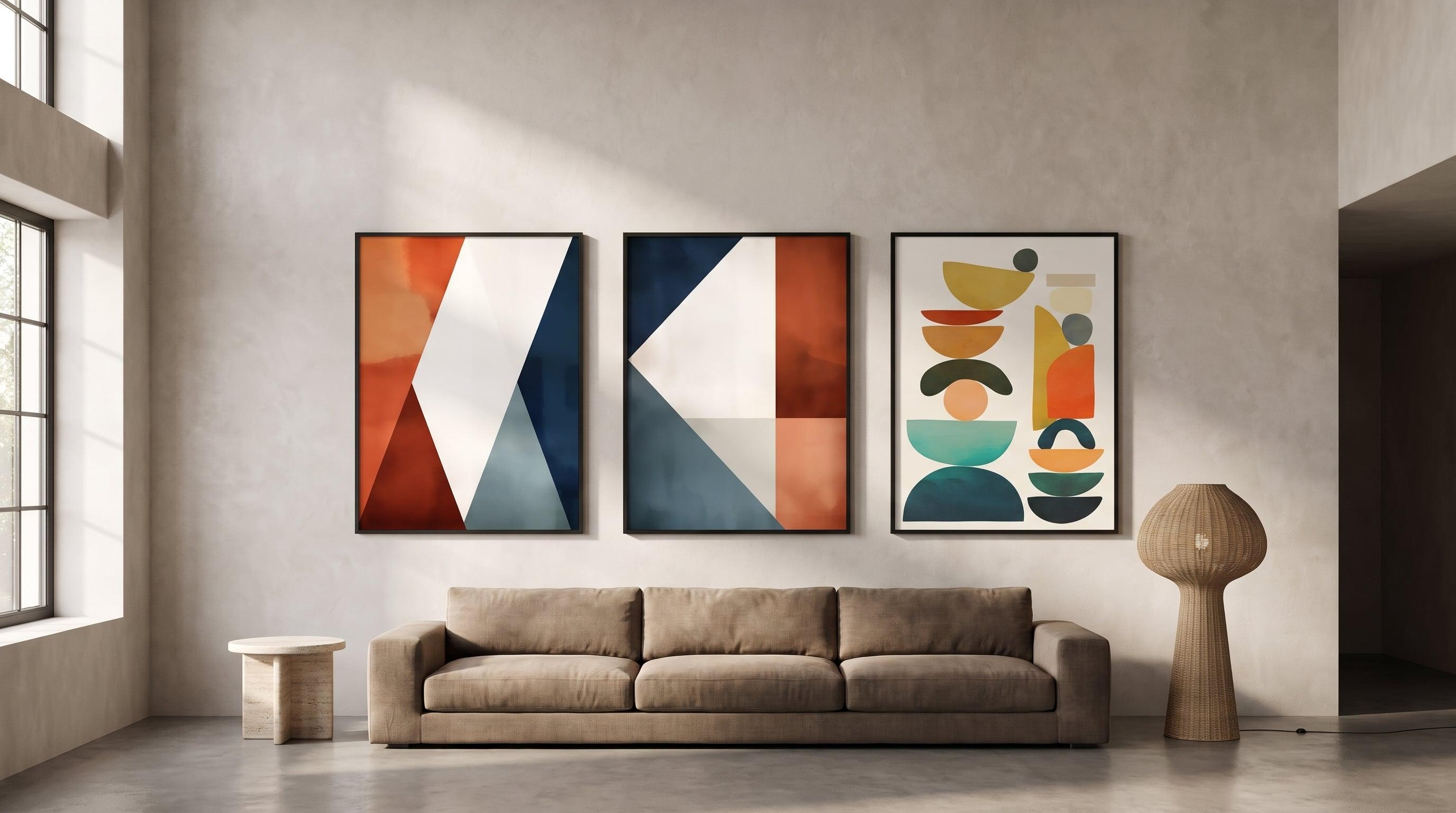
A geometric pattern in A4 can look like a sketch, a playful experiment in shape and colour. The same composition at 100x70 centimetres stops being a sketch. It becomes something else entirely – a statement, almost a building. That's the paradox of scale: the content is identical, but the experience changes fundamentally once the surface grows beyond what we can take in with a single glance.
Abstract art is especially sensitive to this shift, because it rarely asks to be read as an image of something. It asks to be inhabited. And inhabiting requires space. When a field of colour or a line becomes large enough to fill our field of vision, we stop observing it from the outside – we end up inside it.
This is also why large-format abstract art has seen such a surge in how we think about it at home. Not as decoration in the ordinary sense, but as a way of giving a room direction, a centre of gravity that doesn't tell a story but creates a state of mind – something we explore further in our guide on reading visual language beyond the motif.
When the Small Becomes Monumental
Hilma af Klint's series The Ten Largest was painted on an enormous scale from the very start – tempera on paper, several metres tall, deliberately larger than a human body. The shapes themselves are simple: circles, spirals, flowing lines in pink, orange and yellow, a visual language that in a small format could easily be read as ornamental or even childlike. At large scale, something else happens. The lines stop being decorative gestures and become architectural elements instead – columns, arches, horizon lines.
This says something essential about how abstraction works. The visual vocabulary itself doesn't determine whether a work is experienced as playful or serious; scale does. The same spiral that charms at small size can, at large size, require you to literally tilt your head back to take in the whole – and that physical movement itself changes your relationship to the image.


Geometric Abstract Art at Architectural Scale
Geometric abstraction rests on a promise of order – straight lines, clean surfaces, a composition that reads logically. In small format, it easily becomes graphic, almost like a logo. Enlarge the same shapes and that order starts to resemble blueprints rather than illustrations: fields meeting fields at sharp angles, blocks of colour dividing the wall the way a façade divides a street.
It's no coincidence that this type of abstraction is often associated with the architecture and design of modernism. Large, clean surfaces have always had a spatial quality – and in poster formats above 70x100 centimetres, that quality becomes clear in a way a smaller print simply can't convey. If you want to dig deeper into how lines and shapes interact, our guide on geometric abstract art – shapes, lines and balance is a good place to start.


The Colour Field That Surrounds You
Vasily Kandinsky painted his Improvisations as exactly that – improvisations, quick emotional outbursts of colour and form, not planned compositions. At book-page scale, they feel intimate, almost private. In large format, the relationship changes: the fields of colour stop being objects to view and start functioning as spatial events, surfaces that extend beyond the edge of your gaze.
This is one of the most tangible effects of scale in abstract art – the line between seeing a colour and existing within it. A small yellow surface is a detail. A large one is a climate.


Material and Texture, Enlarged
Another branch of abstraction works not with pure colour and form but with structure – cracks, folds, marbling, surfaces that evoke stone, paper or fabric rather than paint. Here, scale does something particular: details that are barely visible in small format become almost tactile when enlarged. A cracked surface at 100 centimetres wide can be read as a landscape; a crumpled sheet of paper becomes a topography.
This is art that pretends to be documentary – a magnification of something material – but is, at its core, just as constructed as the strictest geometric work. The difference is that it imitates physical reality rather than abandoning it altogether.


Letting the Format Speak
There's a case for not compensating for a large abstract piece by filling the wall around it. The format has already done the work – it takes up space, it sets the scale for the rest of the room, it gives the eye somewhere to rest without demanding an explanation. A single large print can often do more for a room than several smaller ones, precisely because it doesn't compete for attention – it owns it.
Bold, warm compositions work differently here than the cooler geometric works – they pull the eye rather than structure the room, and at large scale that pull becomes harder to ignore. How you weigh that feeling into the whole naturally depends on the room itself, something we cover in the guide on choosing abstract art to match the mood of your room.


Frequently asked questions
- What counts as large format for abstract art?
- At Care of Posters, formats go up to 70x100 centimetres, which in most homes is the threshold where a piece stops working as an image on the wall and starts functioning as part of the room's architecture.
- Do large abstract posters work in smaller rooms?
- Often better than you'd think. A single large piece gives a room a clear sense of direction, while several smaller images can feel fragmented in a limited space.
- Do geometric abstraction and colour field painting hang differently at large scale?
- Yes. Geometric abstraction tends to structure a room – the lines create direction and balance. Colour field painting does the opposite; it dissolves structure and gives the room a more mood-driven feel.