
Geometric Abstract Art – Shapes, Lines and Balance
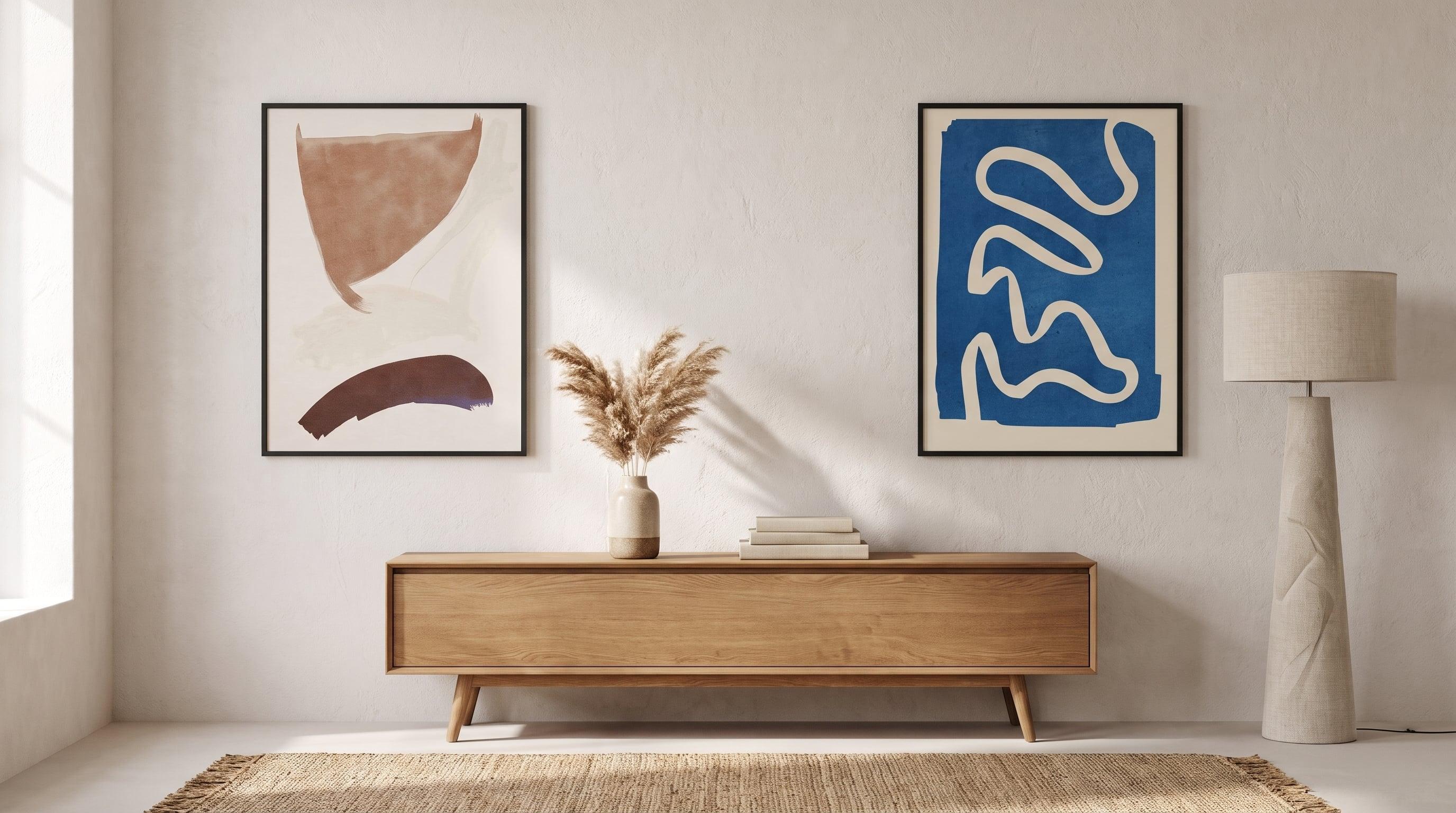
A straight line doesn't say much on its own. But place it against another, let them meet at a precise right angle or drift apart in an offset rhythm, and suddenly something resembling an argument emerges. Geometric abstraction works with the smallest possible vocabulary – circle, square, triangle, line – and shows just how much tension, movement and even emotion can fit into shapes with no counterpart in the visible world.
It's an expression with deep roots: Bauhaus, De Stijl and Russian Constructivism built their entire visual language around the idea that form and structure could carry meaning without depicting anything at all. That logic lives on, but has slipped into a contemporary context where grids and symmetry are just as likely to meet soft pastels, bold colour blocks or optical illusions that toy with the eye's expectations.
What makes geometric abstract art so interesting to read is precisely this balance – between order and tension, between the predictable and what breaks the pattern. If you want to dig deeper into how abstract imagery works more broadly, there's a wider guide to reading abstract art beyond the motif. Here are a few ways of looking at this particular expression, along with some prints that show just how broad the register really is.
The tension of the line within the strict grid
There's a particular kind of unease – in the most interesting sense of the word – in works built on impossible lines. When perspective collides with logic, when a shape appears to fold back on itself, the eye is forced to work. It's the same principle behind Escher's optical constructions: the line is precise, strict and mathematically correct in every single segment, yet the sum refuses to add up.
On a less dramatic scale, it's about how a simple grid can create depth without a single shaded area. Minimalist compositions in blue and grey, built from straight segments and clean angles, show how little is needed to create movement across an otherwise still surface.


The Bauhaus legacy and the grammar of geometric form
The Bauhaus school did something radical when it reduced visual art to an alphabet: the circle, the square and the triangle were meant to carry the same emotional charge as a face or a landscape. Kandinsky's theories on form and colour, where every basic shape was linked to a feeling and even a tone, remain an invisible undertone in much of the geometric art produced today.
This is most evident in prints that directly reference the lithographs and poster art of that era – tight compositions, limited colour palettes, a sense that every shape sits exactly where it should. But the legacy also lives on in warmer, more contemporary interpretations, where the same strict forms meet a softer, more personal colour palette.


Repetition and the calm of symmetry
If the line creates tension, repetition is its counterweight. A pattern that recurs at exactly the same pace – same shape, same spacing, same angle – gives the eye somewhere to rest. It's the same mechanism that makes a checkered floor or a symmetrical façade pleasant to look at: the brain recognises the structure and stops searching for deviations.
Series built on nearly identical shapes, where only a shade or an angle sets the variants apart, work especially well together – as variations on a theme rather than standalone pieces. A grid pattern in soft tones balances in the same way between playfulness and structure, a reminder that symmetry doesn't have to be cold to be precise. You can read more about how this kind of pattern interacts with a room's overall character in the guide to choosing abstract art to suit the mood of a room.


The contrasting power of colour blocks in geometric art
Josef Albers spent much of his career exploring how one and the same colour can look completely different depending on what surrounds it. That idea – that geometry is as much a way of studying colour as it is form – is clearly visible in prints where bold blocks of colour meet along sharp edges. The contrast makes the colours seem to vibrate against one another, even though each surface is entirely flat.
Here, form becomes almost secondary; it's the meeting of colour fields that creates the depth. A composition in warm, saturated tones can feel full of movement even though nothing in the image actually moves, simply because the colours push against each other in just the right way.


When the circle meets the line
The most interesting moments in geometric abstraction often occur at the point where the round meets the straight. The circle is soft, without corners, without direction – it rests within itself. The line is its opposite: directed, decisive, headed somewhere. When the two meet in the same composition, a negotiation between stillness and movement arises that rarely feels static.
Works that build their composition around circular shapes in soft texture, or that let a single straight line divide an otherwise round surface, show how much balance can be found in such simple means. This is art that asks for time rather than a quick glance – the longer you look, the more relationships between the shapes you begin to see.


Frequently asked questions
- What characterises geometric abstract art?
- This expression is built on basic shapes such as circles, squares, triangles and straight lines, often in strict compositions with no representational subject. The tension arises from how the shapes relate to one another – in angle, repetition, colour and proportion.
- How does geometric abstraction connect to Bauhaus?
- The Bauhaus movement formalised the idea that simple geometric shapes could carry meaning and emotion on their own, a notion that still shapes much of today's geometric art – both in direct references to the era's visual language and in freer interpretations.
- Do geometric posters work well with other abstract styles?
- Yes, strict geometric works often pair well with more painterly or organic abstract prints – the contrast between hard lines and loose brushstrokes can make a gallery wall feel more dynamic.