
Abstract Art for the Home – Reading Visual Language Beyond the Motif
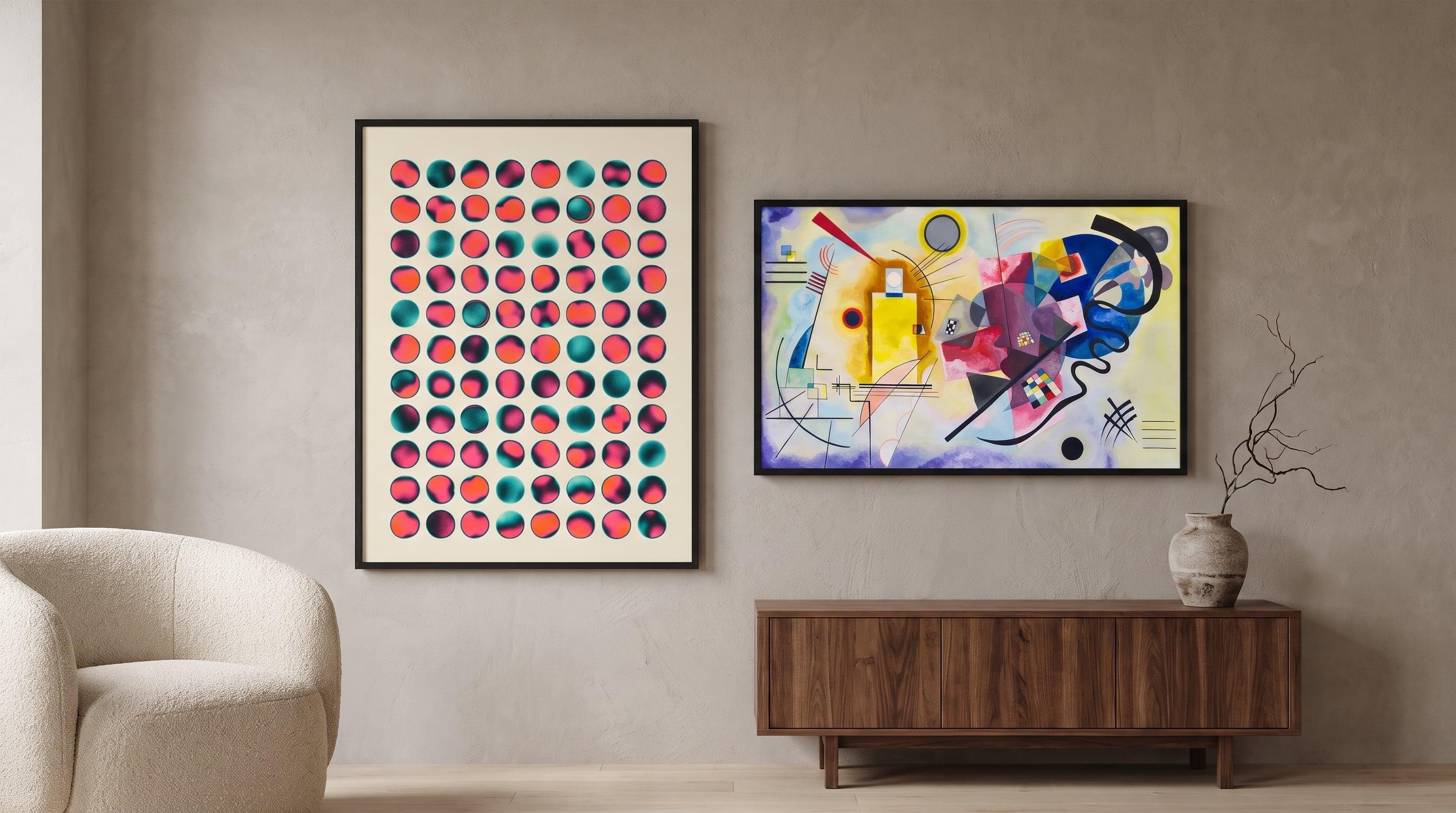
You're standing in front of a painting that doesn't depict anything you can put a name to. No trees, no faces, no horizon to orient yourself by. Yet something happens – your eye is drawn to a particular corner, a field of colour feels heavy or light, a line seems to move even though it's standing still. That's where abstract art begins: not in what you see, but in how you see it.
Many people approach abstract art feeling like they're missing the code to understand it. But abstract art doesn't require a key in the traditional sense. It operates on a different contract between artwork and viewer – one where meaning arises through relationship rather than recognition. Colour against colour, form against empty space, movement against stillness. It's a language you learn to read by spending time with it, not by decoding it.
This article is a broad introduction to abstract visual language: where it comes from, how it works visually, and how you as a viewer can approach the expression without searching for a motif that was never meant to be there.
What is abstract art – and what does it do to a room
Abstract art deliberately refrains from depicting reality in a recognisable way. It's an art form concerned with its own building blocks – colour, form, line, surface, composition – rather than with illustrating something outside itself. That doesn't make it empty of content. On the contrary, an abstract surface can carry just as much mood, tension or calm as a portrait or a landscape, purely through how its parts relate to one another.
In a room, abstract art functions differently from figurative motifs. It doesn't tell a story you can read to its conclusion, but remains open – a presence that shifts depending on light, viewing angle and your own state of mind. That's part of its appeal: it never fully settles, but keeps generating new impressions long after it's been hung.
The logic of colour in abstract painting
When the motif disappears, colour is often the first thing you encounter – and the thing that shapes the experience most. In abstract art, colour carries its own meaning, detached from objects. Red doesn't need to be an apple to feel warm or aggressive. Blue doesn't need a sky to feel cool or deep.
Artists working abstractly often use colour as a compositional tool rather than a descriptive one: large fields that balance each other, contrasts that create tension, or muted, related tones that lend the surface a sense of calm. That's why an abstract painting can feel so different depending on context – the same shapes in a different palette produce an entirely different expression.


Form, line and composition in abstract visual language
If colour sets the tone, form and composition are what guide the eye's movement through the image. Geometric abstraction works with clear, often repetitive shapes – circles, triangles, straight lines – that create rhythm and structure. It's an art form that likes to balance on the edge between order and tension: a shape that's almost but not quite symmetrical, a line that breaks the pattern.
Other works are more organic, built from soft, flowing forms that avoid strict geometry in favour of something more bodily and intuitive. What both directions share is that composition does the job the motif would otherwise do – it creates an inner logic for the eye to follow, again and again.


From Kandinsky to today – abstract art through history
Abstract painting emerged in the early 1900s as a break with art's long-standing mission to depict the world. Wassily Kandinsky, often cited as one of its pioneers, saw abstraction as a way to reach something more direct than representational imagery – an art that spoke to feeling without the detour of recognition, almost the way music does. His works from this period remain reference points for how colour and form can carry spiritual or emotional weight entirely without a motif.
A hundred years on, abstract visual language is just as alive, but has branched out in countless directions – from rigorous geometry to loose, painterly expression. What unites historical pioneers with contemporary artists is a shared belief that form and colour can carry meaning on their own, without borrowing authority from a recognisable subject.


Reading an abstract painting as a viewer
There's no answer key to find in front of an abstract painting, which can feel uncomfortable if you're used to art "meaning" something specific. Another way to approach it is to change the question: not "what does this depict" but "what does this do to me". Which direction does your eye travel? Does the surface feel dense, or does it breathe? Is the composition at rest or in motion?
Abstract art rewards slow looking. Unlike a figurative motif, which often reveals itself at first glance, an abstract surface keeps moving under the viewer's gaze. It's an art to live with rather than decode once and for all – and that very openness is why it continues to engage, regardless of era or style.
Choosing abstract art for your wall
Because abstract art isn't governed by a motif, choosing it often becomes more a matter of feeling and composition than theme. Ask yourself what movement, density or colour temperature you want in the room, rather than what the image depicts. A soft, painterly surface gives a room a different tempo than a sharply geometric composition – both are abstract, but they speak different languages.
It's also entirely possible to combine several abstract expressions on the same wall: geometric against organic, muted against vibrant. The tension between different abstract registers can hold a wall together just as well as a uniform style, as long as there's a shared pulse – in the colour range, in the brushwork, or in how the pieces breathe together on the wall.


Frequently asked questions
- What's the difference between abstract and non-figurative art?
- The terms are often used interchangeably, but abstract art can originate from a real subject that's been simplified or distorted beyond recognition, while fully non-figurative art never had a concrete source at all – it's built purely from form, colour and composition.
- Does abstract art have to mean something specific?
- No. Many abstract works aren't meant to be interpreted as symbols for something else, but are meant to be experienced directly through colour, form and composition. Meaning arises in the encounter with the viewer rather than as a hidden message to uncover.
- How do I know which abstract painting is right for me?
- Start with how the work makes you feel rather than what it depicts. Notice whether the composition feels calm or tense, whether the colours are warm or cool, and whether that expression matches the mood you want in the room.
- Is abstract art harder to interpret than figurative art?
- It calls for a different way of looking, but not more prior knowledge. Figurative art gives you a subject to start from, while abstract art asks you to notice form, colour and movement instead – a skill that grows the more time you spend with the work.