
Art in the Guest Room – Decorating with Posters for Visiting Guests
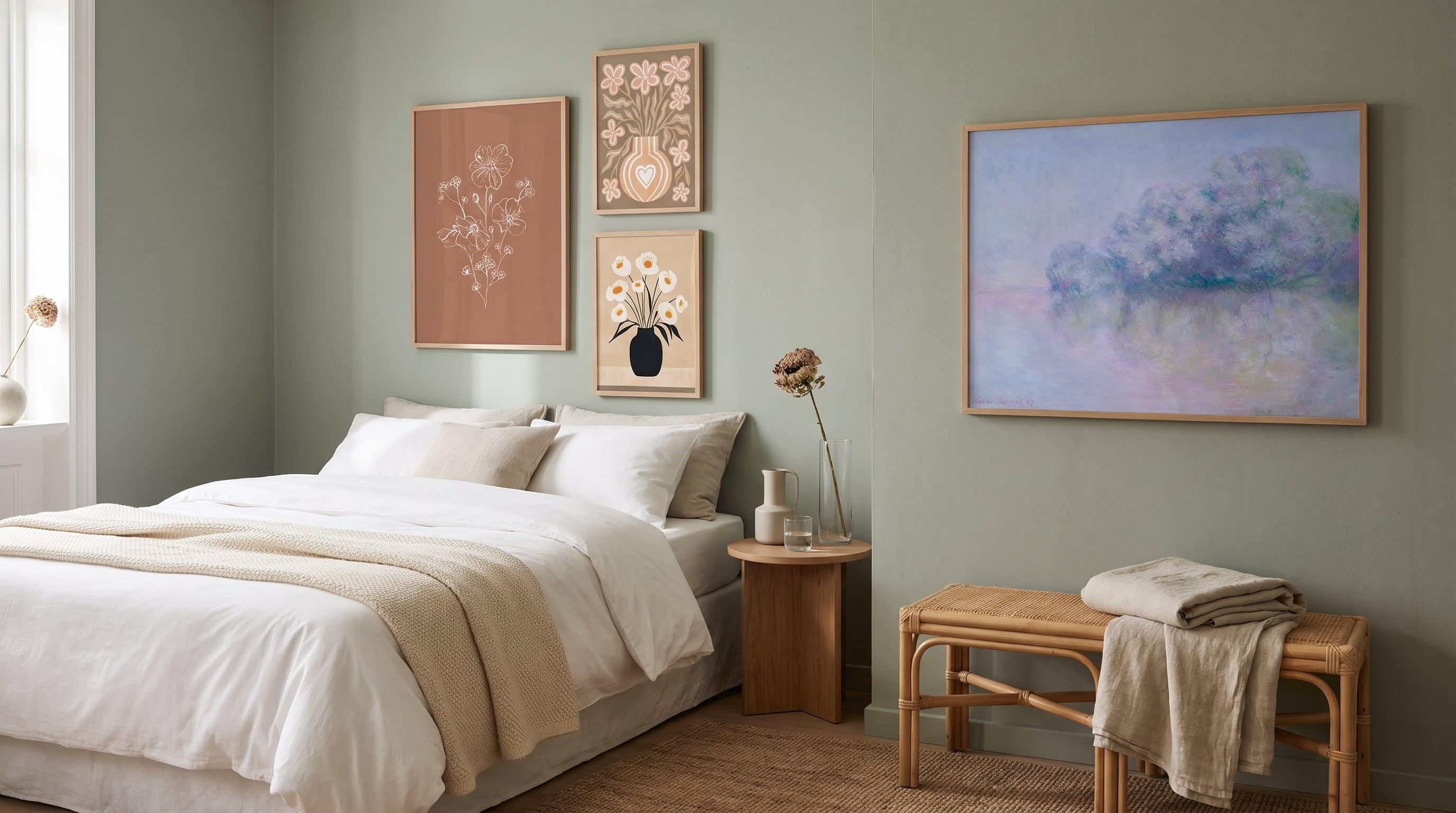
The guest room leads a double life. It should feel considered but not intimate, personal but not revealing. Unlike your own bedroom, where the walls are welcome to carry traces of taste and memory, the guest room is a space for someone else – a sister visiting, a colleague staying overnight, a friend between flights. That's exactly why choosing posters for a guest room is trickier than it seems.
Many default to the safe option: a bare wall, maybe a mirror, nothing to disturb. The result is rarely wrong, but it's rarely memorable either. A guest room with no visual expression at all tends to signal storage rather than care – as if the room is waiting to become something, instead of already being something.
The solution isn't about covering the walls with bold statements, but about finding motifs that are generous rather than challenging. The kind of art that feels warm no matter who's sleeping there.
The Guest Room Dilemma – Too Impersonal, Too Private, or Somewhere In Between
The trouble with guest rooms is that they rarely get to be the main event. They inherit furniture from other rooms, a bed that would otherwise sit in storage, a dresser that never quite fit in anywhere else. Art risks falling into the same category – a forgotten print, left over from ages ago, rather than a deliberate choice.
At the same time, it's easy to overcorrect in the other direction and fill the room with the most personal things you own: children's drawings, holiday photos, things that tell the story of your particular family. For a guest staying one night, that can feel like stepping into someone else's diary. The sweet spot that actually works lies somewhere in between – motifs with feeling, but without a clear narrative that demands explanation. The same balance between rest and reflection is discussed in the bedroom as an art space, just shifted to a room where the guest, not you, should feel at home.
Motifs That Add Warmth Without Getting Too Personal
Flowers are a universal exception. They carry emotion without carrying history – no guest needs to know whose bouquet it is, or why these particular roses ended up on the wall. A densely composed floral bouquet, or a simple vase against a dark background, gives the room softness without asking anything of the viewer in return.
What separates a good guest room motif from a mediocre one is often the light within the image. Dark, muted tones can feel heavy in a room meant to signal welcome, while lighter palettes – white, dusty pink, green – breathe a bit more space. Chrysanthemums in blue, or a bouquet against black that still feels airy, work because they stand with one foot in the decorative and one in the artistic. The same principle appears among calming bedroom motifs – it's about lowering the tempo rather than raising it.


Borrowed Character – Art History as a Shortcut
A simple trick for anyone who wants the guest room to feel curated rather than thrown together is to borrow authority from art history. A Monet print – an ice floe, a park view, palm trees against Mediterranean light – carries a sense of recognition that most people share without necessarily being able to explain why. It gives the room weight without requiring the guest to share your personal taste.
The advantage of older paintings in this context is that they rarely feel trend-driven. They don't date the way a fashionable graphic motif does, and they work just as well in a room used a few times a year as in one with guests every weekend.


A Neutral Base, But Not a Bland One
Abstract art has a particular advantage in the guest room: it tells no specific story, which, paradoxically, makes it more inclusive. A watercolour study in nude and sand, or a soft composition in white and blue, gives the room direction and mood without pointing to a clear aesthetic preference the guest either shares or doesn't.
These are motifs that work as a foundation rather than a focal point – they hold the room together visually, especially if you combine more than one poster on the same wall. And unlike an empty, unpainted space, a neutral abstraction still feels like a decision, not the absence of one.


Scale, Placement, and That Sense of Being Well Thought Out
Guest rooms are often smaller than your own bedroom, which means the choice of size matters more than you'd think – much like the reasoning in small bedroom, big impact. A poster that's too large can feel overwhelming in a room that already feels compact, while one that's too small easily gets lost alongside a bed, a nightstand, and perhaps a suitcase on the floor.
- Position posters above the guest bed roughly the way you would in an ordinary bedroom – the same guidelines around poster placement above the bed apply here: too high and it loses its connection to the bed, too low and it feels clumsy.
- Two smaller prints in a pair often create more balance in a narrow room than one large piece.
- Avoid borderless prints in very small formats – a thin white border around the image can make it feel more like art and less like a sticker on the wall.
It's rarely the most expensive or striking motif that makes a guest room memorable. Usually it's enough that someone has chosen something – with a bit of care, without turning it into a statement.
Frequently asked questions
- Which motifs work best in a guest room?
- Motifs that carry feeling without requiring explanation tend to work best – flowers, calm landscapes, classic paintings, or soft abstraction. Avoid strongly personal photos or motifs with a clear political or religious charge.
- How large a poster should I choose for the guest bed?
- It depends on the width of the bed and wall, but a common guideline is that the motif or group of motifs should cover roughly two-thirds of the bed's width to feel balanced.
- Should I use several posters or just one in a small guest room?
- Both approaches work. In really small rooms, a single, well-chosen poster can feel more relaxed than several smaller ones competing for attention.