
Small Bedroom, Big Impact – Posters for Compact Spaces
A small bedroom rarely lies about its dimensions. Every piece of furniture negotiates for space, every wall is already claimed by a bed, a dresser, or a window demanding its share of room. That's precisely why art choices matter more here than in a room with generous surfaces to fill. Where a large living room can handle an entire wall of mixed formats and motifs, the small bedroom calls for something else: discernment.
It's tempting to think that more art solves the problem of a small room—that more pieces create life and personality. Often the result is the opposite. In a room of twelve square metres, the eye reads every surface quickly, and a dense collection of posters can make the wall feel restless rather than interesting. What works in a loft with high ceilings becomes cramped and heavy in a bedroom with low ceilings and narrow wall sections.
The question, then, isn't how to fill the walls, but how to edit them down. Which expression suits the room best, and how much breathing room does it need around it to function as rest rather than decoration. Choosing posters for a small bedroom is about understanding the room's own proportions, not about following a general rule for wall decor.
The Room's Logic: Why Less Is More
A small bedroom has shorter sightlines. You rarely view an entire wall from a distance—your gaze meets it at an angle, from the bed, on your way out the door, in the dawn light before you're fully awake. This changes how art should function in the room. A composition meant to be experienced from four metres away in a hallway doesn't say the same thing when it hangs a metre from the headboard.
In tight spaces, every addition becomes more visible, and every empty space more significant. It's an entirely different equation than in a room with more walls, where the eye can naturally rest between objects. Here, that rest must be created deliberately—by leaving margin, by choosing a handful of expressions that have something to say rather than many that simply fill space. You can read more about this approach in our guide to the bedroom as an art space, where rest and reflection guide the choice of motifs.
This isn't about minimalism as a style ideal, but practical perception. A room you sleep in needs to read well in dim light and at dawn, not just in photographed daylight.
A Calm Expression in the Right Scale
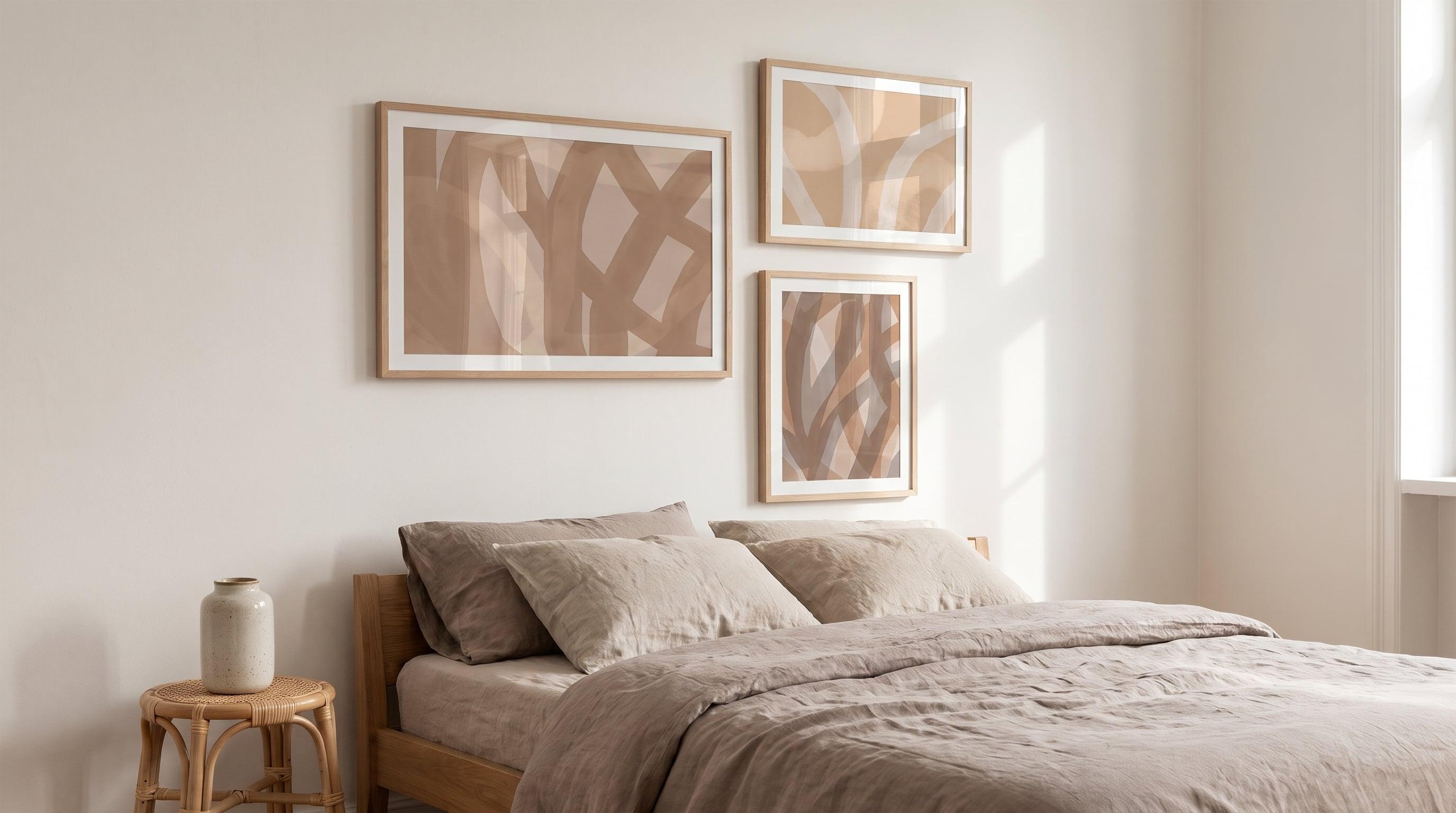
Abstract watercolours in muted, neutral tones are among the pieces that work remarkably well in small bedrooms, precisely because they don't compete with the room's other surfaces. A landscape-format piece above a low dresser, or on the wall facing the bed, can carry the room without dominating it—colours in beige, sand, and light grey blend into the same register as bedding and wood tend to occupy.
What makes this type of work useful in tight rooms is that it rarely requires company. These pieces work alone, as a single breathing pause on the wall, rather than as part of a larger narrative. In a room where space is limited, that's an advantage—you avoid the puzzle of multiple formats that need to balance each other. Those who want to explore which expressions work best specifically for rest can read more about calming motifs for the bedroom.


A Single Piece That Carries the Room
In a larger room, a gallery wall can be the whole point—a composition of several pieces that together build something. In a small bedroom, the same ambition risks feeling fragmented, simply because there's no distance from which to view it. Often the solution instead is a single portrait-format piece at a slightly larger scale: a work with enough presence to fill its share of the wall without reinforcement.
Motifs with quiet figuration—a still life, a gently melancholic scene, a warm autumn-toned composition—work well in this role. They give the room direction without requiring you to fill the rest of the wall for it to feel complete. One single piece, placed correctly at eye level from the bed, often does more for the experience than three smaller ones competing for attention. If you want concrete measurements to work from, check our guide on poster placement above the bed—position, height, and size.


Small Groupings in Square and Portrait Formats
Sometimes you still want more than a single expression, and in that case, square and narrow portrait formats are preferable to wide landscape compositions—they take up less width and can be placed closer together without feeling crowded. A grouping of two or three pieces, hung at even intervals rather than in a classic grid formation, can work even on a narrow wall between door and window.
The key is keeping the palette cohesive. A couple of pieces in related colour tones, ideally with similar brightness, read as a unit even when hung more loosely than a traditional gallery wall would require. This creates a sense of curation rather than a random collection—exactly what a small room needs for the art to feel considered rather than just filler.


Frequently asked questions
- How many posters work well in a small bedroom?
- There's no exact limit, but in small rooms, one or a few well-chosen pieces often work better than a full-scale gallery wall. Let the proportions of the wall and bed guide you—if the space feels tight even without art, choose one strong piece rather than several smaller ones.
- Should posters in a small bedroom be large or small?
- A common mistake is choosing formats that are too small, assuming they'll suit a small room better. Often a somewhat larger format, well placed, creates a calmer feeling than several small pieces that create visual restlessness.
- Does abstract art work better than figurative art in small bedrooms?
- Not necessarily, but abstract and understated motifs tend to blend into the room's overall feel without requiring as much space around them, which often makes them practical in compact rooms.