
Posters for Shared Kids' Rooms – Art Made to Share
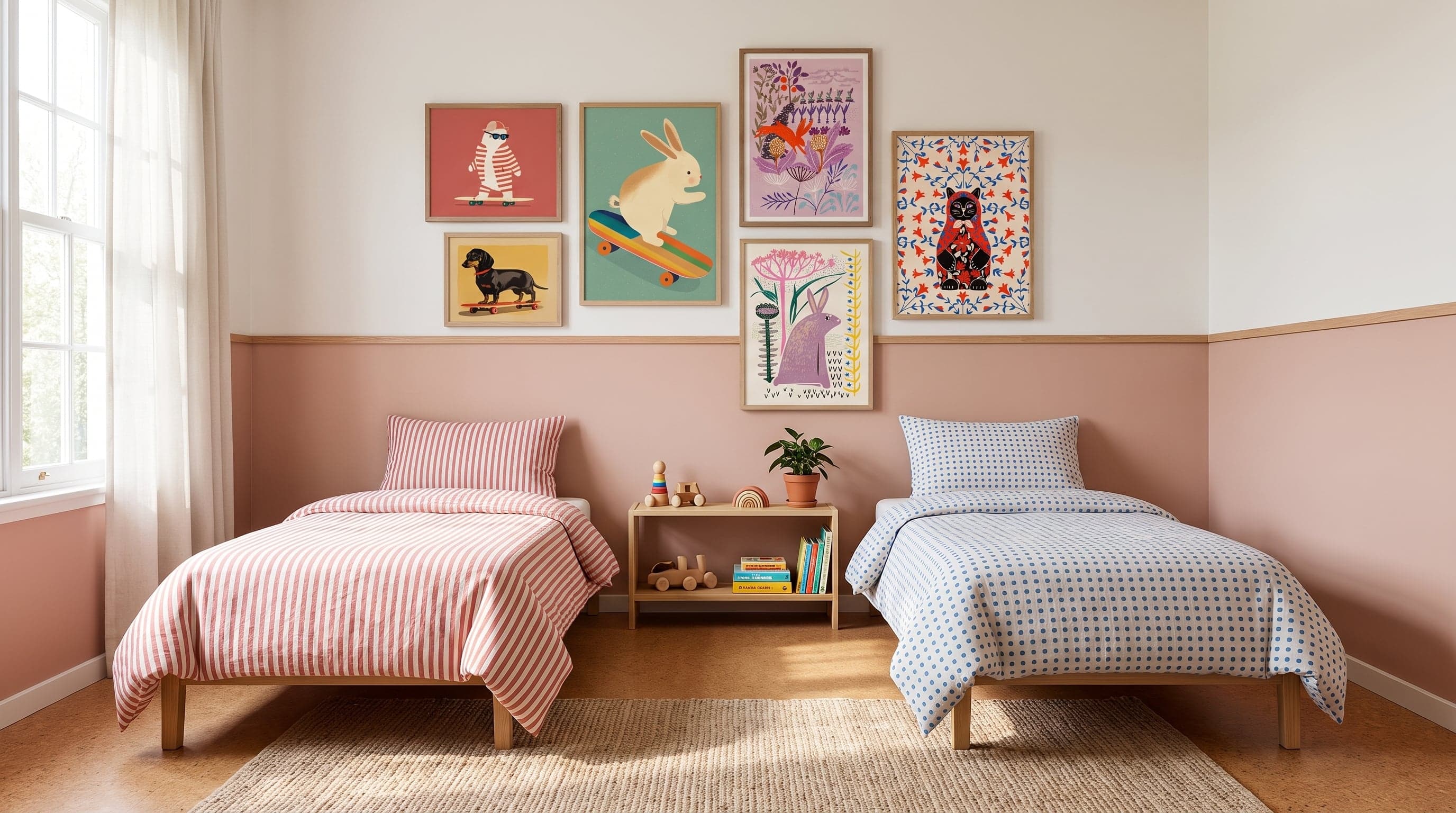
Sharing a room with a sibling is an exercise in compromise long before the walls even enter the picture. Two children, two tastes, often several years apart in age – and a single room that has to make space for both teddy bears and dragons, both calm and high-energy play. That challenge shows up most clearly in what ends up on the walls.
The easy answer is usually to pick something neutral enough not to upset anyone, but that's rarely what brings a room to life. It's better to think in themes and series – motifs that speak the same visual language while still leaving room for different personalities. A poster of a skateboarding bear and one of a quiet moonlit scene don't have to feel like two different rooms, as long as the colour scheme and mood tie them together.
Choosing posters for a shared kids' room ultimately comes down to balance: neither child should feel like a guest in their own room, while the whole still needs to hang together aesthetically. With the right selection of art, that's entirely achievable – without anyone having to give up their favourite motif.
Two kids, one room – and different ideas about what looks good
Anyone who's shared a room with a sibling remembers the negotiations: whose poster gets to hang where, whose taste gets to take up the most space. It's rarely about money or square footage – it's about identity. A child's room is one of the first places kids get to express who they are, and sharing that space with someone else – especially a sibling at a completely different age or stage – calls for a different kind of planning than a room meant for one.
The solution is rarely to pick the most neutral option for everyone. It's more about finding a common thread – a colour scheme, a mood, a series of motifs – that lets different expressions coexist without competing. Just like in an adult home where several tastes share the same living room, it's about creating a dialogue between the pieces rather than muting the differences. If you want to dig deeper into how to think about art in kids' rooms more generally, there's a broader guide to posters for kids' rooms to start from.
A common thread to hang everything on
One of the easiest ways to create cohesion in a shared room is to let the same type of motif recur in different variations. A series of animals on skateboards, for example – in the same spirit as popular animal motifs for kids' rooms – works just as well for a five-year-old as for a ten-year-old, since the humour and movement in the images blur the age gap. It becomes a shared joke on the wall rather than a compromised choice.
This kind of series also makes it easier to let each child pick their own animal, their own character, without the whole feeling disjointed. All three prints can share the same tone, the same playful line, while still being clearly different creatures – which mirrors exactly the dynamic between siblings.


Same hand, different motifs
Another approach is to draw from a single artist's visual world. Graphic patterns, recurring colours and a distinctive line can hold a room together even when the motifs vary – a rabbit, an artichoke, a babushka-shaped cat. It's the same brushstroke and sense of composition that ties them together, rather than a specific theme.
For siblings of different ages, this can be a way to avoid the room feeling like it belongs to either the younger or the older child. Instead, it becomes a shared visual world that both can feel at home in, regardless of which motif is actually the favourite.


Room for different moods on the same wall
Children sharing a room are rarely in the same phase at the same time. One might want something dreamy and soft to fall asleep to, while the other wants something that feels more adventurous and forward-looking. If the youngest sibling is still a baby, it may also be worth looking into how to approach posters for the nursery before making the first choices. Here, not all the posters need to mean the same thing – it's enough that they share a similar softness in palette or a similarly calm tone to work together.
A child who paints clouds, one who aims for the moon, and a motif where sun and rain meet can hang side by side without clashing, since they all move within the same poetic register. It's a difference in content, not in feeling – and it's exactly that kind of difference that makes a shared room interesting to grow up in.


Swedish folklore as a shared reference point
Motifs rooted in Swedish folk art – Dala horses, tomtar, animals in graphic style – have an advantage in shared rooms: they're recognisable enough to feel reassuring, yet still open to interpretation. A pink Dala horse isn't read the same way by a three-year-old as by a nine-year-old, but both can appreciate the colour and shape.
That makes this type of motif a good complement when a room already has a couple of more personal choices on the walls. They act as a shared foundation, a kind of visual base, around which the rest of the room's characters can gather.


Frequently asked questions
- How do you choose posters that suit children of different ages in the same room?
- Look for a common thread – the same series, the same artist, or the same colour world – and then let each child choose their own motif within that framework. This creates cohesion without either child having to fully compromise on their taste.
- Should siblings have exactly the same motifs on their walls?
- No, that's not necessary. What holds a room together is more about a similar tone, palette or style – not identical images. Different motifs within the same visual language usually work better than forcing perfect symmetry.
- How big should posters be in a shared kids' room?
- It depends on the room's proportions and how many motifs need to share the wall. Smaller formats work well for groupings of several images, while a single larger print can serve as a backdrop above a bed or reading corner.
- Can you swap out posters as the children grow?
- Yes, that's often a good strategy for a room meant to last several years. Choosing freestanding prints rather than fixed wall murals makes it easy to swap out individual motifs as tastes change, for example when it's time for a more <a href="https://www.careofposters.se/guider/posters-tonarsrum">teen-appropriate feel</a>.