
Posters for Kids' Rooms – A Guide to Motifs, Height and Mood
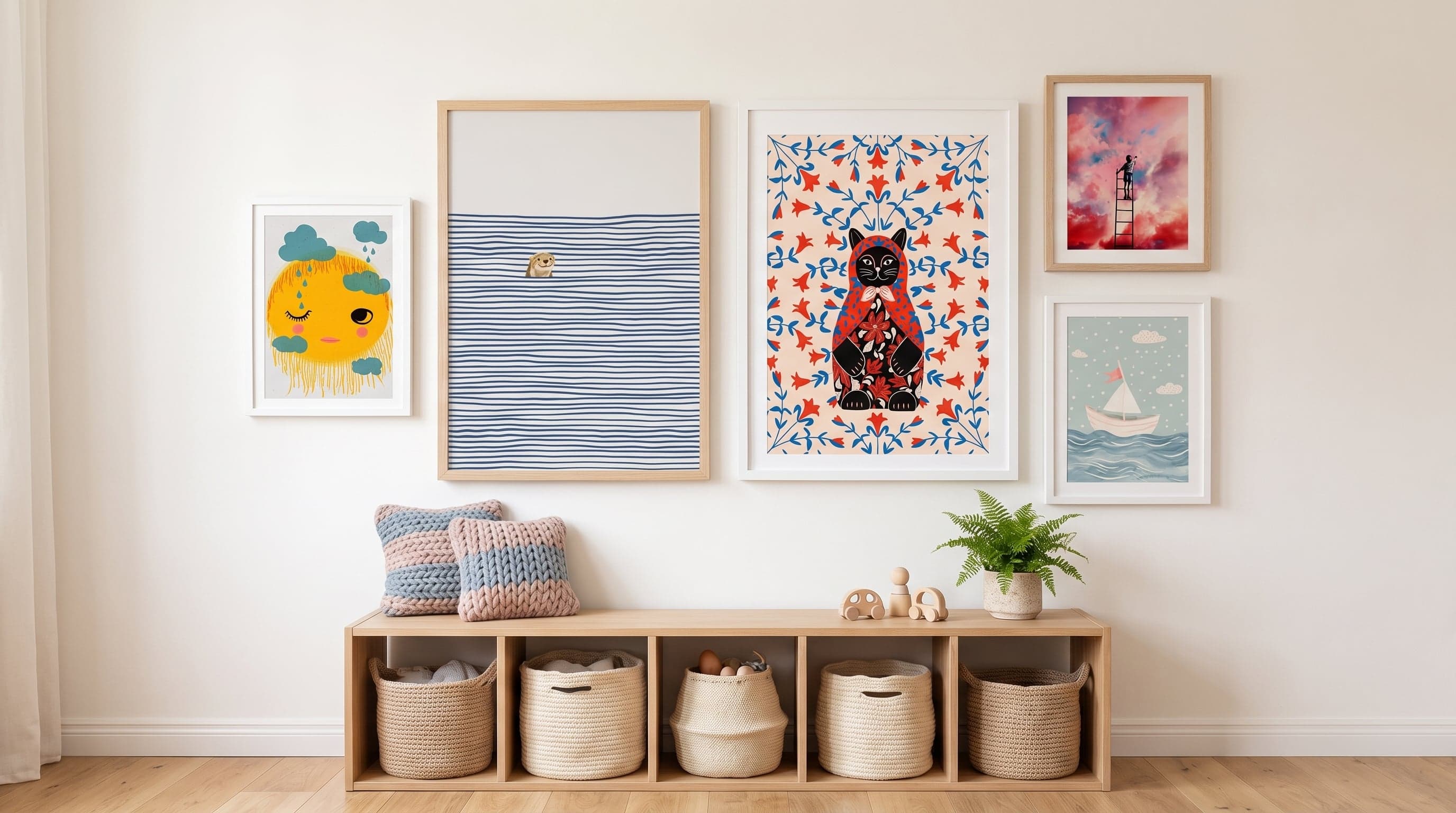
A child's room rarely stands still. It gets rearranged, repainted, filled with new interests at the same pace the child itself changes – from cot to loft bed, from a star-shaped night light to posters of a favourite team or band. The art on the walls might be the one thing that gets to stay through several of these phases, if you choose wisely from the start.
Hanging posters in a kids' room isn't about finishing a decorating job. It's about creating a room with space for imagination without becoming silly, one that feels safe without being childish, and one that works just as well when the child is two as when they're twelve. That calls for a different way of thinking than in the living room – both about the motifs themselves and about where on the wall the picture should actually hang.
The room changes along with the child
Most adult rooms are furnished with a degree of future-proofing in mind – you expect the sofa to still be there in ten years. Kids' rooms work the opposite way. A two-year-old's room and a ten-year-old's room rarely share the same needs, the same play patterns, or the same view of the world. That makes choosing art a more dynamic task: you're not just picking something for how the room looks now, but for how it can carry through several chapters.
A strategy that works well for many parents is to separate what's tied to a specific age – a teddy bear, a fairy tale, a favourite character – from what has a more timeless quality: a shape, an animal, a sense of movement or curiosity. The latter kind of motif simply ages better alongside the child.
Motifs that spark curiosity and imagination
The best kids' room motif is rarely the most literal one. An illustration that hints at a story – an animal mid-movement, a character on its way somewhere – gives the child something to fill in themselves. That's the difference between looking at a picture and living inside it.
Animals are a recurring theme for a reason: they carry both recognition and a bit of distance at the same time. A bear riding a skateboard or a rabbit in motion doesn't feel like a textbook illustration, but like a scene from something bigger. That kind of illustration works just as well in a small craft corner as above the bed, and rarely gives the sense of the child "growing out of" the picture after just a couple of years.
- Movement and adventure open up space for the child's own stories, rather than dictating one.
- Animal motifs act as a bridge between the familiar and the imaginative.
- Graphic, playful styles tend to age better than overly sweet or distinctly childish ones.
Height, placement and the child's perspective on the wall
In adult rooms, art usually hangs at the eye level of a standing adult – a rule of thumb rarely questioned. In a kids' room, that rule suddenly becomes irrelevant. The child's gaze meets the wall from an entirely different height, and that height changes every six months or so.
One approach is to place the main motif somewhat lower than instinct suggests – roughly at the child's eye level when sitting on the floor or in bed, rather than when an adult is standing upright. That way, the picture is actually seen and experienced by the person who lives in the room, not just by visitors. By the bed, it often works well to hang a little lower than convention dictates, while a wall above a dresser or play area can follow standard gallery height, since it's rarely viewed up close.
Many also choose to group several smaller formats instead of one large piece – this leaves room to swap and add pieces as interests change, without having to redo the whole wall.
Colour palette and mood in the details
Colour does more work in a kids' room than you might think. Bold hues spark energy and play, while softer, more muted tones create a room that feels calming to fall asleep in. Most rooms benefit from a combination – a play wall that gets to be lively, and a sleep wall that breathes a little more.
Motifs featuring water, sky and natural forms – waves, clouds, soft animal shapes – have a way of creating calm without becoming bland. They work as a counterweight to the toys and textiles that already bring colour and pattern into the room.


When the story gets to take centre stage on the wall
Some motifs carry a whole little world within them – a journey, an escape, an adventure unfolding in the image. These work well as a kind of permanent bedtime story, something the child can return to and discover new details in each time. This type of illustration is often especially well suited to rooms where the art needs to do more than decorate; it should give something to talk about at bedtime.
How you build on that feeling differs depending on where in life the child is – the art for a baby's room meets entirely different needs than art meant to stay once the room is shared with a sibling, or once the child starts wanting a say in what hangs on the walls.


Curiosity as a starting point for choosing motifs
Regardless of age, it's rarely wrong to start from what the child is already curious about – animals, vehicles, space, water – and look for illustrations that take that interest seriously without making it overly educational. Art that respects the child's imagination, rather than simply illustrating it, tends to last the longest.


Frequently asked questions
- How high should you hang posters in a kids' room?
- Lower than in adult rooms, at least for art meant to be seen from the child's own height – for example by the bed or play area. Think from the child's sitting eye level, not a standing adult's.
- Do childish motifs get boring quickly?
- Often, yes, especially if they're tied to a specific age or trend. More open-ended motifs – animals in motion, natural shapes, hinted-at stories – tend to hold interest longer.
- Should all the posters in the room share the same style?
- No, but it helps if they share a common feeling in colour or line work, so the wall feels cohesive even when the motifs vary.
- Can you swap out posters as the child gets older?
- Absolutely, and many do. Choosing a few more timeless motifs as a foundation, and adding pieces that reflect the child's current interests, makes it easy to update the room without starting over completely.