
Animal Posters for Kids' Rooms – Motifs That Spark Curiosity
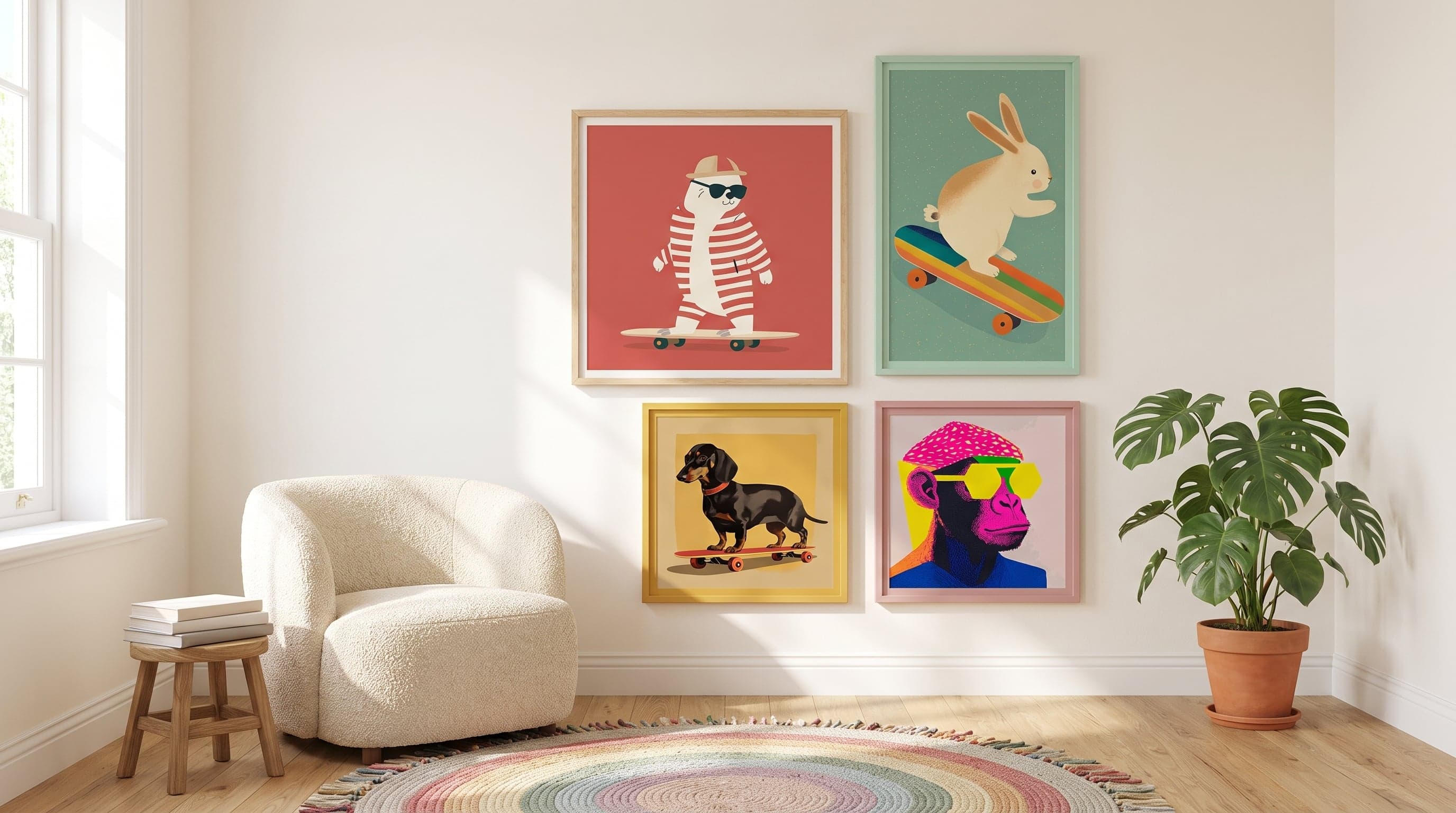
There's something in an animal that children understand before they have words for it. A fox peeking out from a bush, a teddy bear on roller skates, a hedgehog that looks like it's about to sneeze – these motifs need no explanation. They speak directly to someone who is still learning to read the world through shape and colour, not text.
Perhaps that's why animal motifs are so hard to shake off in children's art. They return generation after generation, taking different forms depending on the taste of the time – from naive storybook illustrations to sharper graphic interpretations that could just as easily hang in a living room. It's precisely that range that makes animal posters for kids' rooms so interesting: the choice isn't just about which animal, but about what feeling the room should carry. If you'd like to work through the reasoning step by step, our guide to kids' room posters covers motifs, hanging height, and overall mood.
Why animal motifs never go out of style in the kids' room
Animals act as a kind of universal language in children's visual world. They carry emotion – courage, curiosity, clumsiness, warmth – without needing explanation. An illustrator can make a rabbit look frightened just through the angle of its ears, or a bear seem comforting through the way it sits. It's a simplification that isn't simplistic, but rather distilled.
At the same time, the animal motif has a long history in art more broadly, from scientific studies to the symbolic figures of folk tales. When it enters the kids' room, it often carries traces of both – the scientific interest in form and the narrative interest in character. That duality is part of why these motifs age so well; a child grows into new layers of meaning within the same image. If you're facing this choice even before the baby arrives, our guide to posters for the nursery is a good place to start.
Playful four-legged animal posters
The most immediate category is pure playfulness – animals doing human things with unwavering seriousness. A bear on a skateboard, a dachshund on roller skates, a rabbit balancing on wheels. The humour lies in the contrast between the animal's nature and the activity it's performing, and the illustration style is often simple, with clear outlines and flat blocks of colour that work even from a distance.
This type of motif suits rooms where the energy should be upbeat, where the wall is allowed to be just as chatty as the toys on the floor. These prints rarely take themselves seriously – and that's the whole point.


When the animal motif turns sharper and more graphic
Another thread in the history of animal motifs is the more investigative one – illustrations that resemble patent drawings, scientific diagrams, or old encyclopaedias. The lines are thinner, the palette often restrained in beige, grey, or blue, and the animal is presented almost as a subject of study rather than a character. A teddy bear drawn as a technical construction is a good example: the motif is still childlike in origin, but the expression is mature and graphically clean.
This direction works for parents who want animal motifs without the room feeling like a toy shop – a poster that can follow the child all the way into the teenage room without feeling outdated. The surreal touch, as in a rabbit interpreted with traces of classical portraiture, also belongs here: the motif is animal, but the gaze is artistic rather than cute.


Animal posters in nature's own colours
A third register draws its tone from nature rather than the storybook. Here, animals aren't anthropomorphised but depicted in their own environment – an otter diving through waves, hummingbirds in flight, a rabbit among flowers. The palette often follows the landscape: blue water, green leaves, earthy tones. This gives a calmer impression than the playful skateboard motifs, more contemplative than comic.
For rooms where you want to preserve a sense of the outdoors and the seasons, rather than pure fantasy, this is often the right direction. Jungle motifs, with their dense greenery, belong here too – they build a sense of adventure without needing a clear storyline.


Folk animal motifs with history and symbolism
Some animal motifs carry a cultural anchoring that makes them more than decoration. The Dala horse is one such example – a Swedish folk art figure that, through generations, has come to represent both cosiness and craft tradition, and which in a more modern interpretation can feel as much art as symbol. The low, round shape of the Russian babushka doll sometimes reappears as an animal motif and plays on the same recognition: a form we already know, filled with new content.
Weaving such a motif in among the more playful or nature-inspired ones gives the wall a layer of storytelling – a connection to place or tradition that the child may not yet understand, but that the parent does.


Frequently asked questions
- Should animal posters in a kids' room be playful or more artistic?
- It depends on the feeling you want the room to have. Playful motifs with clear outlines bring energy and humour, while sharper, more graphic interpretations – like patent drawings or nature studies – give a calmer, more timeless impression that often lasts longer through the child's growing years.
- Can you mix different styles of animal motifs on the same wall?
- Yes, as long as the palette or visual language has something in common. Letting a couple of playful motifs meet a more nature-inspired or graphic animal often creates a more interesting wall than if everything comes from the same register.
- What size works for animal posters in a kids' room?
- Smaller formats work well for a collection of several motifs, while a single larger animal motif can serve as the room's clear focal point. You can choose freely among sizes from 21x30 to 70x100 cm depending on wall space and desired feel.