
Poster Above the Bathtub – Height, Angle and Composition
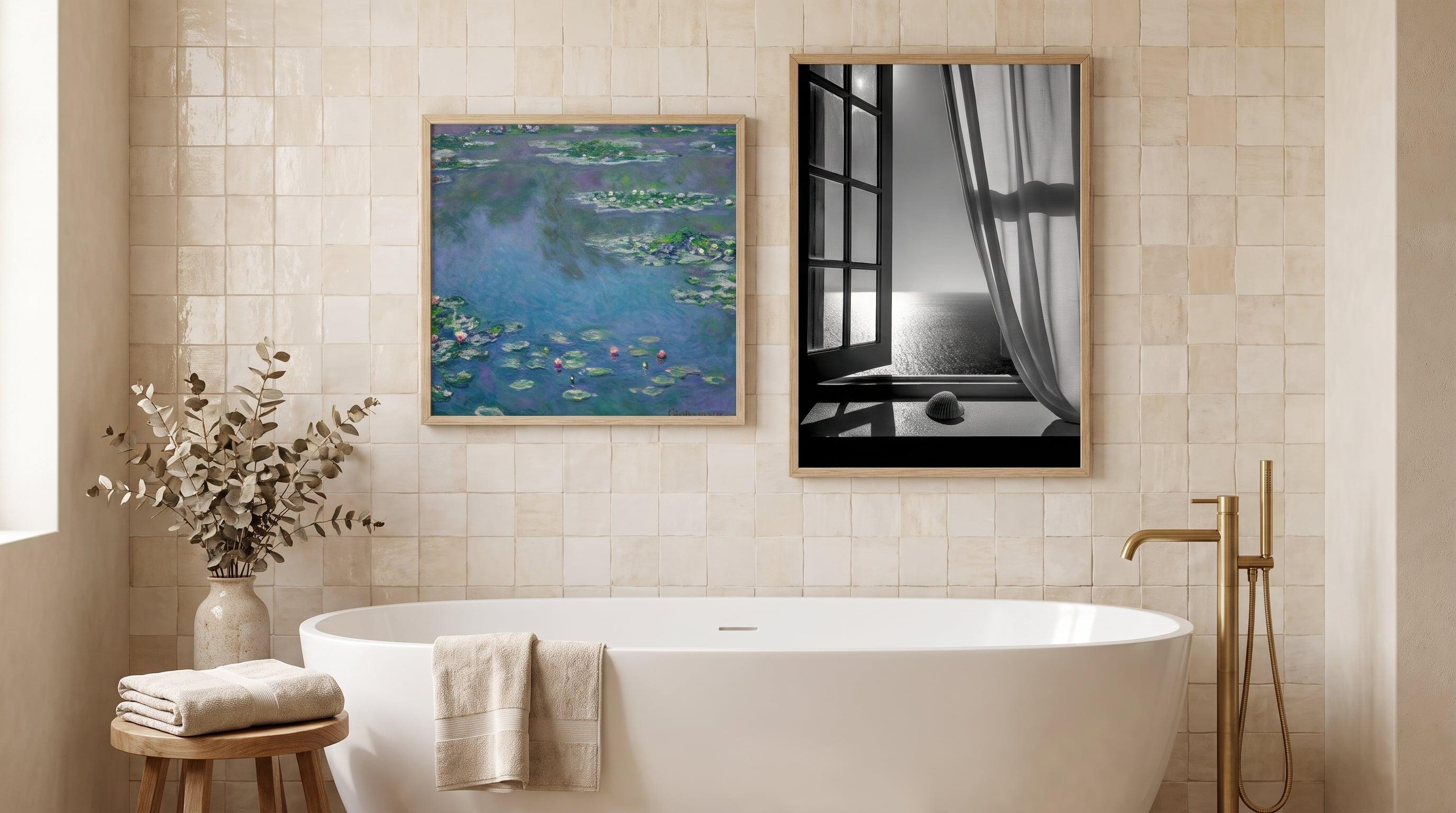
Most people hang art as if everyone in the room were standing up. But in the bathroom you spend a good deal of time lying down, neck against the rim, gaze directed slightly upward or straight ahead across the water's surface. That's a different perspective from the one we normally use when measuring up a gallery wall, and it changes both where a poster should sit and how high.
The real question isn't simply where a poster above the bathtub should hang, but who's looking, and from where. Someone lying in the water sees something entirely different from someone standing at the sink brushing their teeth, or someone just passing the doorway on their way to the shower. Three sightlines, three heights—and if you only plan around one of them, the rest of the room risks feeling off.
The View from the Tub – What You Actually See Lying Down
Lie down in a bathtub and test it yourself: the eye's natural line rarely runs straight up to the ceiling—it angles forward toward the wall at the foot of the tub, or along the side wall if the tub sits lengthwise. A poster hung directly above the head, behind the neck, is effectively invisible to the person bathing—you only glimpse it in passing as you step in or out.
If you want the art to be visible specifically during a bath, the wall at the foot end is often the more interesting surface, not the wall directly above the tub. And since the gaze sits lower when you're reclining—closer to chest height than standing eye level—it often works better to hang something a bit lower than convention dictates, around 100–130 cm (39–51 in) from the floor, depending on the tub's height and how deeply you recline.
Calm, visually quiet motifs work well on this kind of surface. Water meets water, in a sense—a feeling echoed in our spa-inspired posters for the bathroom.


At the Sink – A Completely Different Height
Shift your gaze to the sink and everything changes. Here you stand upright, eye level is the usual one, and the art can follow the same logic as in the rest of the home—center of the piece roughly at relaxed eye height, around 150–160 cm (59–63 in), depending on ceiling height and how close the mirror sits.
It's also at the sink that details have time to register. You stand still for a few minutes each morning and evening, close enough to read text or notice a fine line in an illustration. This is the spot for pieces with humor or a delicate touch—things that reward close inspection without feeling overbearing at first glance.


The Angle and Format That Shape the Composition
The wall above a bathtub is rarely very wide, which makes a portrait format a natural choice—it follows the body's direction in the room rather than cutting across it, something that becomes especially clear in a small bathroom, where composition and space are closely linked. A landscape or square piece can work too, but usually needs more breathing room around it to avoid feeling cramped against the edges.
Also consider the distance between the poster and the water's surface. Steam rises, and the concentration of moisture and heat directly above a full tub is at its highest closest to the water—something worth reading more about in our guide to how posters hold up against bathroom humidity. A reasonable rule of thumb is to let the poster's lower edge sit well above the taps rather than right next to them, so it occupies the room's air rather than its most humid zone.
Composition here is as much about where the eye rests as what's on the wall. A motif with playful movement—animals in water, a witty nod to the ritual of bathing—can turn a narrow wall from feeling like a corridor into feeling like a scene.


The Sightline at the Door – The Bathroom's First Impression
The first impression of a bathroom is rarely formed by the person bathing, but by the person opening the door. Here the same guidelines apply as in a living room or hallway: the piece should catch the eye immediately, at a height that feels natural for a standing viewer, ideally with contrast or a graphic quality visible even in dim light.
This is also the wall where you can afford to be a little bolder—a statement piece rather than something that sets a quiet mood, since it's rarely in the direct path of moisture. For more examples of placement and motifs for the whole room, see our broader guide to posters in the bathroom.


Frequently asked questions
- How high should a poster hang above the bathtub?
- It depends on whether you want it visible while bathing or while standing in the room. For it to be readable while lying down, hang it lower, around 100–130 cm (39–51 in) from the floor, ideally at the foot end rather than directly above the head. For someone standing and looking into the room, follow standard gallery height of around 150 cm (59 in).
- Should the poster be placed directly above the tub or on another wall?
- Directly above the head, it's rarely visible during an actual bath since the reclining gaze points forward, not straight up. The wall at the foot end or side of the tub usually offers a better sightline.
- Does the poster's format matter in a narrow bathroom?
- Yes. Portrait format follows the room's narrow proportions better than landscape, especially on walls with limited width above a tub.
- How close to the water's surface can a poster be?
- Let it sit well above the taps rather than right next to them, since moisture and steam are most concentrated closest to the water.