
Can Posters Handle Moisture? What You Should Know About Art Prints in the Bathroom
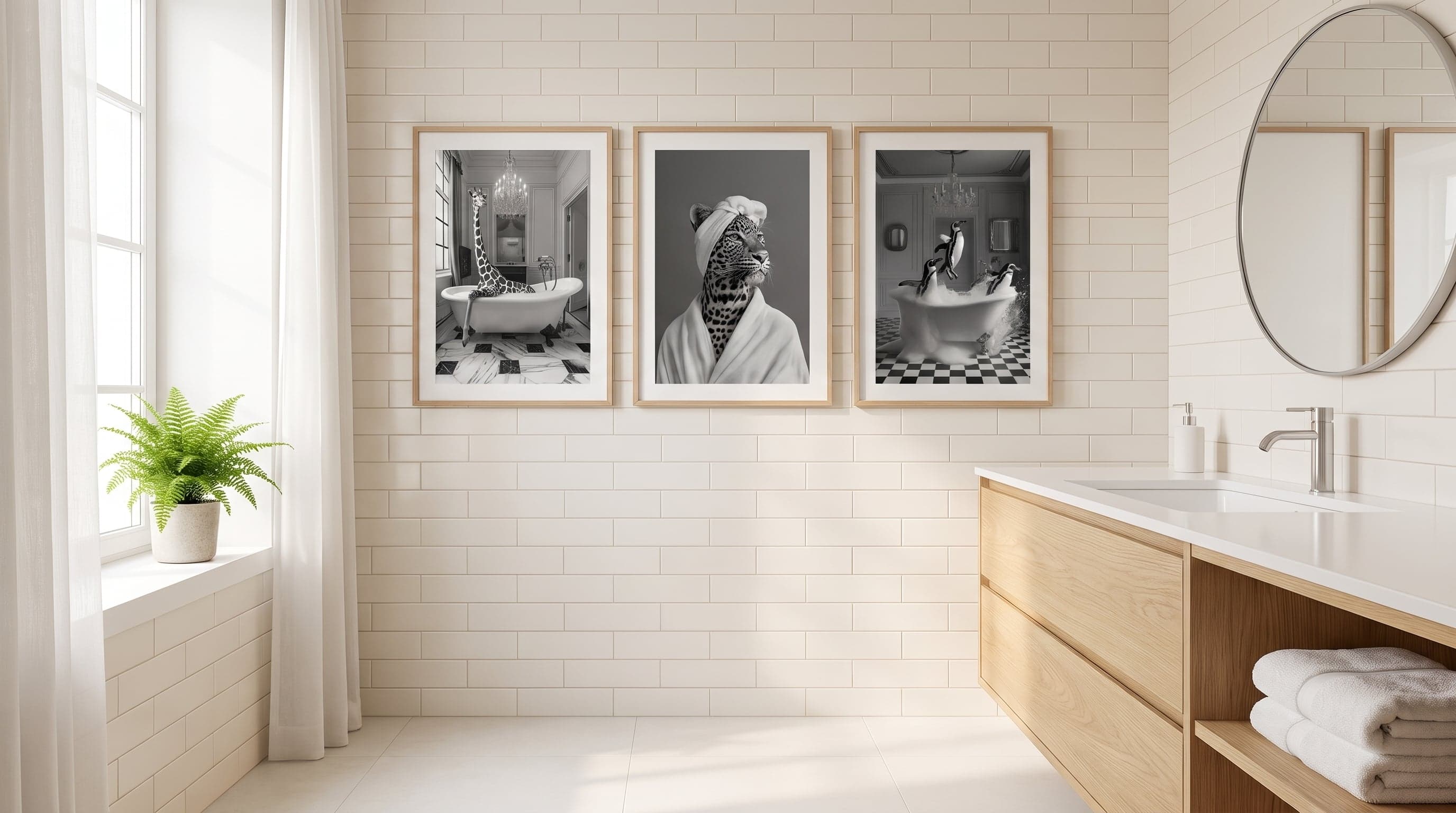
The question comes up every time someone wants to hang posters in a room with a shower: can the paper withstand the steam? The short answer is that moisture always affects paper in some way – the question is how much, where, and for how long. A bathroom is rarely the extreme climate we imagine, but it isn't neutral either. Water vapour, temperature shifts and condensation do something to cellulose fibres that no other room in the home does at the same rate.
That doesn't mean the walls should be left bare. It means that placement and ventilation play a bigger role than in the living room, and it's worth understanding why before hanging up something you love.
What moisture actually does to paper
Paper is hygroscopic – it absorbs and releases moisture depending on the relative humidity of the air. In a bathroom, humidity rises quickly when someone showers, then drops again once the steam is ventilated out. This fluctuation, rather than the moisture itself, is what wears on the fibres most over time. Paper that constantly expands and contracts can develop waves, known as cockling, especially if it's mounted completely flat against a cold surface.
Thicker fine art paper, around 200 gsm, is more resistant than thin offset prints precisely because it has more mass to move within without losing its shape right away. That makes a difference, but it doesn't make the paper waterproof. Condensation left sitting against the surface for long periods is still a problem, regardless of paper quality.
Placement matters more than you'd think
It's rarely the bathroom itself that's the problem, but exactly where on the wall the artwork ends up. The surface closest to the shower cubicle or bathtub meets direct steam surges and sometimes splashes – that's where the risk is greatest. A few decimetres further away, on a wall that isn't in the steam's path, the climate is often not much worse than a bedroom after a night with the window closed.
Think about where condensation actually forms. Tiles and mirrors fog up quickly because they're cold and smooth. A gallery wall positioned a bit away from the water source, ideally on the side where air moves toward the ventilation rather than toward the source, is a much safer spot. For more examples of well-thought-out placements, see our broader guide to posters in the bathroom.


Ventilation is the only real conservator
A bathroom that's properly aired out after every shower behaves completely differently toward paper and ink than one that stays humid for hours. A fan, a window left ajar, or a door propped open for a while does more for the artwork's longevity than any choice of material. The moisture needs to leave, not just spread around the room.
It's also worth wiping down tiles and floors after showering if you share the bathroom with others – the less moisture that lingers in the air, the less work the paper has to do to return to normal humidity.


Graphic designs handle the steam better, visually speaking
No matter how well you ventilate, a bathroom will always have higher humidity than the rest of the flat during certain times of day. This is where the choice of motif actually makes a difference to how the art is perceived over time, even though the paper itself doesn't care what's printed on it. High-contrast, graphic designs – black-and-white patent drawings, line art, bold shapes – don't show it as clearly if the surface temporarily picks up a slight sheen from moisture in the air. The matte, uneven light of a bathroom blends in better with a motif that already relies on contrast than with one built on subtle colour gradients. For more thoughts on what works well in this particular room, see our guide to art in the bathroom.
Twelve-colour giclée prints still offer a depth that holds up regardless of motif, but in humid environments, graphic designs tend to feel more at home visually.


What you can do yourself
A few simple habits significantly reduce the strain on the paper:
- Don't hang art directly in the steam stream or splash zone near the tub and shower.
- Let the fan run for a while after every shower, even if it feels unnecessary.
- Avoid mounting prints directly against a cold exterior wall where condensation forms most easily.
- Check now and then whether the wall behind feels damp – that tells you more than any thermometer.
With these precautions in mind, the bathroom isn't the high-risk art space it's sometimes made out to be. It just requires a bit more thought than a bedroom, not a completely different approach. If you'd like to read more on this whole topic, check out our main guide to posters for the bathroom.
Frequently asked questions
- Can posters be hung directly above the bathtub?
- It's possible, but the risk of condensation and splashing increases the closer the print is to the water source. A placement a bit further away, ideally on a wall that doesn't face the steam directly, is safer over time.
- Does thicker paper make a difference in humid rooms?
- Yes, to some extent. A thicker fine art paper around 200 gsm moves less with humidity fluctuations than thinner paper, but no paper quality is completely unaffected by persistent moisture.
- Do I need extra ventilation if I have art in the bathroom?
- Normal ventilation after showering is usually enough. The important thing is that the moisture actually leaves the room rather than lingering in the air for a long time.
- Will the colours in the print be affected by moisture?
- Giclée prints with pigment ink are stable against fading, but persistent moisture can affect the paper's surface physically rather than the colours themselves.