
Poster, Print or Picture – What's the Real Difference?
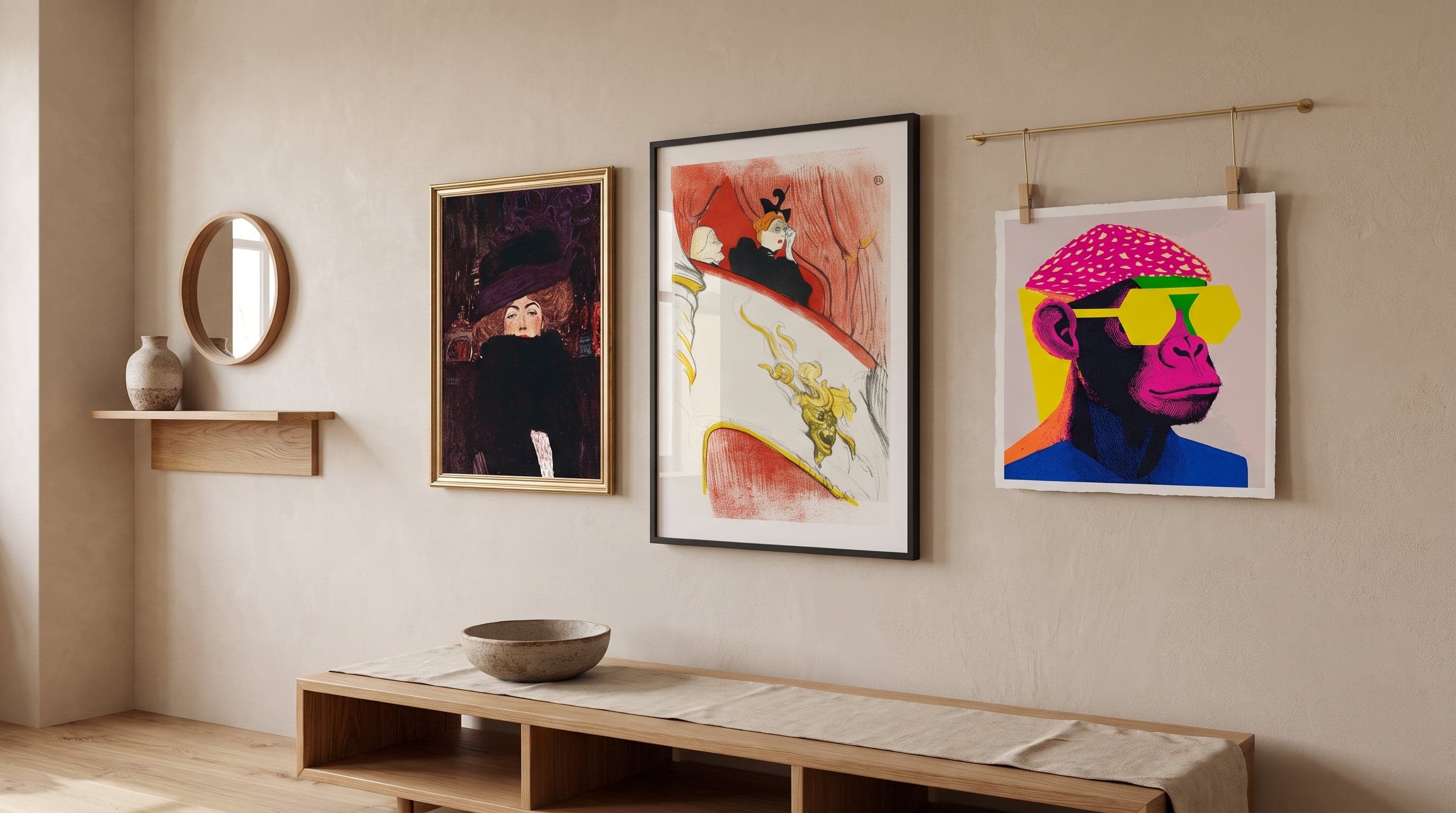
Someone points at the wall and says "what a lovely picture" – even though what you've hung up has never come near a paintbrush. At the till, the same image was called a "poster". In the museum shop, it was labelled an "art print". On a hundred-year-old Parisian backstreet, it was a "poster" of another kind entirely, pasted to a wall to lure people into a cabaret. Same image, several different words, depending on where in time and space it happens to be.
It's no wonder the words drift apart. English itself borrows freely, and the line between a poster, a print and a picture rarely has anything to do with what the image actually is – it's about context, function, and, in some cases, quality.
The Poster's Origins – Art of the Street
The word poster traces back to the idea of posting something publicly – putting up a notice for all to see. Originally, a poster always carried a message: a performance, a meeting, an item for sale. It was meant to be seen in passing, do its job, and then vanish – papered over by next season's poster.
That's why art history is full of posters that were really advertising. Toulouse-Lautrec's images from Montmartre were made to be pasted outside the Moulin Rouge and cabarets like Aristide Bruant's – not to hang framed in someone's parlour. That they're regarded today as artworks in their own right is a retrospective judgement; in their time, they were disposable objects with a sell-by date.
That tension – between the fleeting nature of the street and the permanence of art – is still visible in the poster's visual language: bold typography, flat fields of colour, a composition designed to be read from a distance and on the move.


Poster or Print – When the Word Took Over the Wall
The everyday sense of "poster" as pure decoration is a younger idea, and it carries a different history. It took hold with youth culture in the 1960s and '70s – band photos, film posters, images without a sender or a message, taped straight onto bedroom wallpaper. Unlike the original poster, which always had an errand to run, this kind of poster is fundamentally just an image you want to look at.
Today the words are largely used interchangeably in everyday speech, but a distinction still lingers beneath the surface: a poster in the classical sense often still signals that something is being announced – a political poster, a theatre poster – while a poster in the modern sense is pure décor, free of any message. The question "poster or announcement" is really less about size or material and more about what the image is for.
A quote on the wall, a graphic animal motif, a photograph of a musician – these function as posters in that sense: images chosen for their look, not to advertise anything.


What Do You Call a Picture Without a Frame?
Here things get a little curious. "Picture" has historically meant a painting – an oil on canvas, say. But in everyday speech, the word has broadened to mean any framed image on a wall, whatever the technique. The catch is that being framed is really a precondition for something to be called a picture at all. Lay that same image flat on a table, without a frame, and it suddenly stops feeling like a picture – it's just a piece of paper.
So: a picture without a frame is, strictly speaking, not really a picture at all. It's a print, a poster, or an art print waiting to become a picture. The frame, then, isn't just protection and presentation – it's what linguistically turns the image into what we call a picture.
That also explains why a work like Munch's The Scream can be both at once: the original painting is undeniably a picture, but the print you can hang at home is – before it's framed – a poster or an art print of a picture. The same logic applies to Monet's misty views of Westminster or Derain's vividly coloured portraits: the painting is the picture; the reproduction is something else, until the wall and the frame turn it into a picture of its own once more.


Art Print vs Poster – Quality as the Dividing Line
If the difference between a classic poster and a modern poster is mostly a matter of function, the difference between a poster and an art print is more a matter of craft. A poster in the strict sense was historically printed in large runs on thinner paper, using techniques built for volume rather than detail. An art print signals something else: a process closer to how a gallery or artist would reproduce a work themselves – with a wider colour range, deeper blacks, and paper built to last. Want to dig deeper into what actually defines an art print? We break it down in a dedicated guide.
In practice, the terms are often used interchangeably in shops, but printing with twelve-colour giclée technique on thick, acid-free art paper is a different craft altogether from a simple digital print on thin stock. The difference rarely shows up on a screen – but it becomes obvious when light hits the surface at an angle, or when the print needs to last decades rather than years.
A portrait by Matisse or a strictly geometric composition demands exactly that kind of precision – subtle shifts in colour, sharp contours, a matte surface that doesn't distract the viewer's eye.


Frequently asked questions
- Are posters and prints the same thing?
- In everyday speech, almost always. Historically, they differ in purpose: a poster in the classical sense announces something (a performance, an election), while a modern poster is an image chosen for its look, with no message to communicate.
- What do you call a picture without a frame?
- Strictly speaking, it isn't a picture until it's been framed and hung. Without a frame, it's a print, a poster, or an art print – the word picture really refers to the finished, framed whole.
- What's the difference between an art print and a poster?
- The difference usually lies in quality and process rather than in the image itself. Art prints are often associated with finer paper and printing techniques with greater colour depth, while posters historically referred to simpler, mass-produced prints.
- Does it matter what you call your art print?
- Not for how it looks on the wall. But the words give clues about what you're buying – whether it's a historical document, a decorative image, or a carefully reproduced copy of a work of art.