
What Is an Art Print, Really? A Guide to Quality and Technique
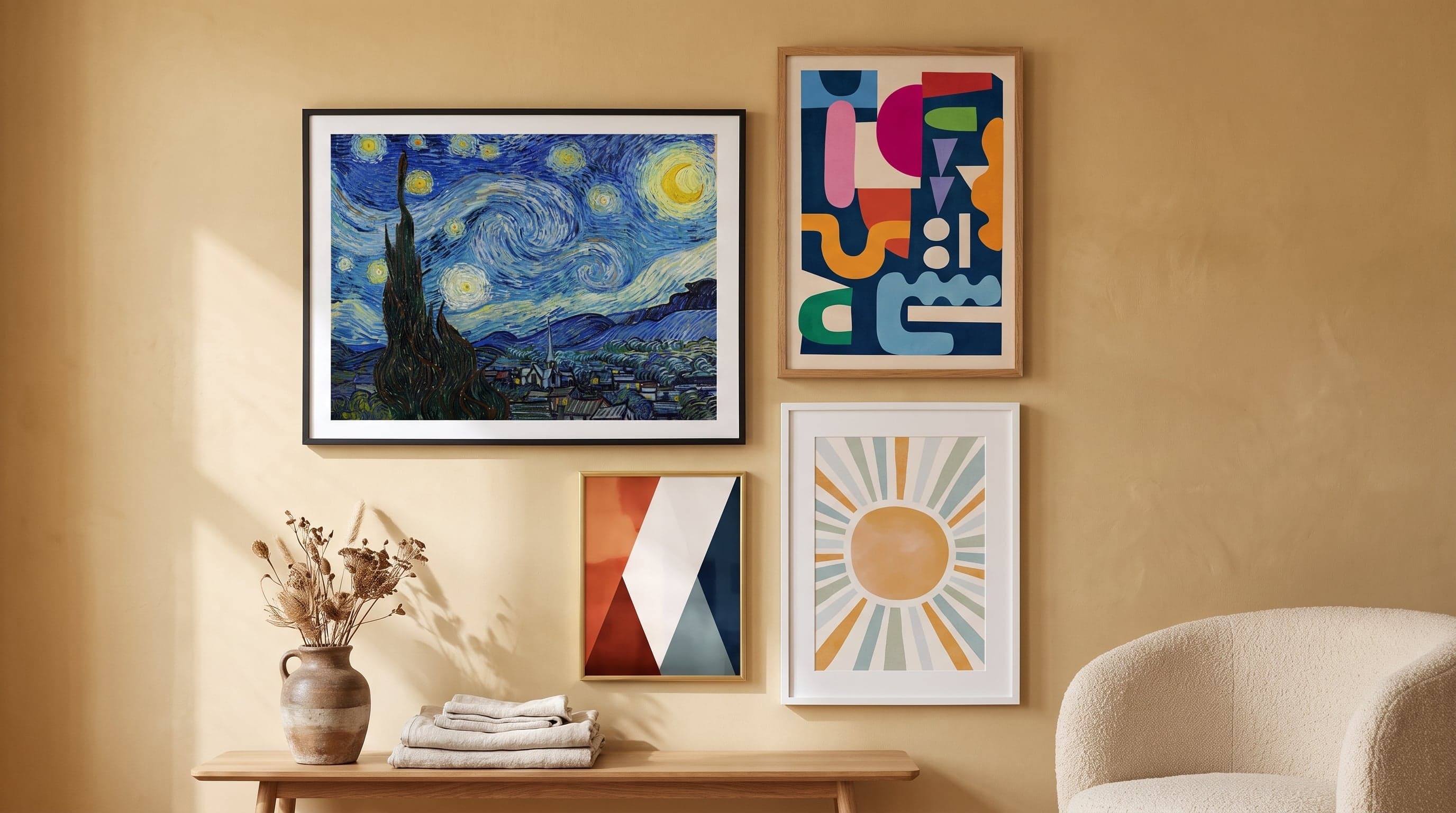
Most of us have never stood in front of the real Starry Night. Munch's Scream hangs behind bulletproof glass in Oslo, and Hokusai's Great Wave exists in only a handful of copies scattered across museums worldwide. Yet we know these images inside out — we've seen them hanging in friends' homes, in offices, in waiting rooms. What we're looking at is rarely the original. It's a print. The question is what kind of print, and what separates a carefully produced copy from one that only looks good on a screen.
But what is an art print, exactly? These days the term gets thrown around rather loosely — as a synonym for poster, as a stamp of quality, as marketing. Yet the concept has a real history and a real technique behind it, and understanding that puts you in a much better position to judge what you're actually getting for your money, no matter where you shop.
Here's the journey from printing press to pixel — and the tricks that reveal quality before you've even touched the paper.
From copperplate to pixel — a brief history
For a long time, reproducing art was a craft in its own right. Copperplate engraving, lithography and woodblock printing required years of training — every colour, every line was carved or etched by hand before it could be printed again and again. Hokusai's famous wave is the perfect illustration of this: a woodblock print where every single shade was built up from separate wooden blocks, one per colour.
With the arrival of offset printing in the 20th century, reproduction became industrial. Images by Munch, Van Gogh and Monet spread in the millions, but often with a simplified colour range and thinner paper — made for volume, not fidelity to detail. It's this technique that has shaped our idea of what a poster is: cheap, accessible, but rarely a very faithful copy of the original.
Digitalisation redrew the map once again. Today, even the smallest brushstroke, texture and colour transition in a work of art can be captured and reproduced with a precision the old printers could only have dreamed of.


What does "art print" actually mean?
The term art print refers to a print produced as a work of art in itself — not a mass-printed poster. The technique that made this possible is called giclée, from the French gicler, "to spray". The name refers to how pigment ink is sprayed in microscopic droplets directly onto the paper, colour by colour, with a precision that preserves even the subtlest transitions of light and shadow.
The difference from older printing methods is especially noticeable in images built on nuance rather than contrast. A giclée process using twelve colours captures far more shades than traditional four-colour printing, which is most obvious in abstract and geometric works, where every tiny shift in colour carries the entire composition.
It's also this technique that has allowed contemporary illustrators and visual artists to work digitally while still achieving results that feel painterly rather than printed.


Poster or art print — where's the line?
In everyday speech the line is blurry, but technically it comes down to three things: process, paper and resolution. Offset printing generally works with four base colours and is produced in large runs on thinner, often coated paper that can have a certain sheen. Giclée uses more colour channels, higher resolution, and is usually printed in smaller runs — each copy ends up closer to an original.
Paper plays a bigger role than most people realise. A thicker, uncoated Fine Art paper with a matte surface absorbs ink differently than glossy paper, producing deeper blacks and a surface that doesn't bounce light straight back into your eyes. FSC-certified paper at around 200 gsm is standard practice for this type of print, built to last without yellowing or cracking along the folds.
In short: an art print isn't automatically better than a poster — but the technique behind it opens up more possibilities for capturing the feel of the original, if it's used well.
How to spot quality in an art print
You don't need to be a printer to judge quality — but it helps to know what to look for. Keep an eye out for:
- The surface. A matte, glare-free finish suggests Fine Art paper rather than photo paper or cheap coated stock.
- Colour depth. Study the transitions — in skies, shadows, skin tones. Uneven, banded gradients reveal low resolution or too few colour channels.
- The feel of the paper. A heavier paper bends differently and feels more substantial in your hands.
- Sharpness of detail. Zoom in digitally before you buy — fine lines and patterns, like the gold ornamentation in Klimt's work or the contours in Matisse's line drawings, quickly reveal whether a print can handle detail.
Artworks with rich decorative surfaces or bold patterns make unusually good tests of print quality, simply because they have nowhere to hide.


The many faces of the art print
What makes today's art prints so interesting is their range. The same technique that reproduces the play of light in Monet's water lilies can just as easily handle the bold, defined lines of abstract and figurative contemporary art. The vivid colour fields of Fauvism, the soft, almost sculptural linework of portraiture, or the clean geometric shapes of modern abstraction — each places different demands on print precision, and each shows just how far the field of art prints stretches today.
It's this variety, rather than any single style, that defines art prints today: the technique has become so flexible that it adapts to the expression, rather than the other way around.


Frequently asked questions
- What is an art print, exactly?
- An art print is a high-quality reproduction of a work of art, typically produced using giclée technique on thicker, matte paper. Unlike mass-printed posters, art prints aim to get as close as possible to the original's colour, light and level of detail.
- What does the term "art print" mean?
- Art print is the English term for a print treated and produced as a work of art in its own right, rather than an ordinary poster — usually made with pigment inks on Fine Art paper.
- What's the difference between a poster and an art print?
- The difference lies in process, paper and resolution. Posters are typically printed using offset technique in large runs on thinner paper, while art prints are often produced using giclée technique with more colour channels on thicker, uncoated paper that delivers deeper colour and better longevity.
- How can I judge the quality of an art print before buying?
- Look at the paper weight, the surface finish (matte rather than glossy), and how smooth the colour transitions are in the product image. Zoom in on detail-rich areas — fine lines and patterns quickly reveal whether a print holds up at high resolution.