
Minimalism at Home – The Art of Leaving Things Out
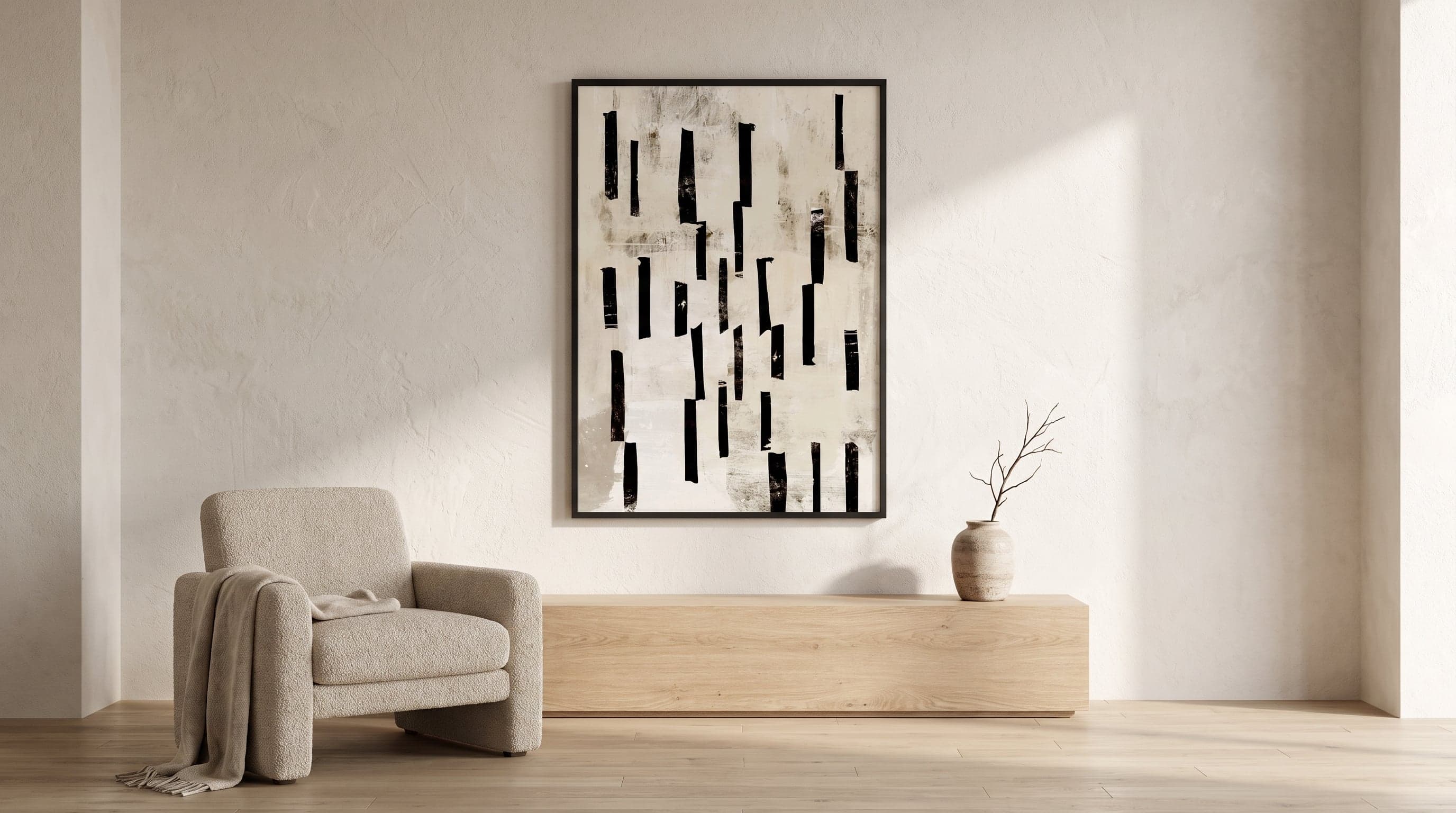
Minimalism has become synonymous with a look – white walls, pale wood, a single plant angled just so. But copying the surface alone misses the point entirely. At its core, minimalist interior design is a series of decisions about what earns its place and what doesn't. It's an approach to space, to belongings, to attention itself.
The hard part is rarely adding something. The hard part is daring to let something stand alone – trusting that a room won't feel cold just because it's sparse. When everything else is dialed down, whatever remains carries far more weight. A single art print can carry a room in a way that ten scattered details never could.
What Minimalist Interior Design Actually Means
It's easy to assume minimalism is about quantity – fewer things, less color, simpler shapes. But what actually makes a room minimalist is the selection process behind the result. What genuinely needs to be seen? What can be removed without the room losing its function or feeling?
That question is uncomfortable in a way shopping rarely is. It's easier to buy one more thing than to decide a wall should stay bare, or that a shelf should have breathing room between objects. Minimalism as a style, then, isn't just an aesthetic preference – it's an exercise in tolerating space that isn't filled.
That doesn't mean austerity. A minimalist room can be warm, even sensual, if what's there has been carefully chosen. It's about concentration rather than absence – a direction that shares much with the bright, airy expression of Scandinavian style, but pushes the reduction one step further. If you want to see how minimalism relates to other directions, it's worth reading more about different interior styles and how to recognize them.
One Print, One Voice in the Minimalist Room
In a room where color, pattern, and detail have been strategically toned down, a single graphic print suddenly speaks loudly – in a good way. It gets room to say something, instead of competing with cushions, gallery walls, and ornaments for attention.
This is where a strong visual language works best: clean lines, clear contours, a figure or composition that holds together even from a distance. A black-and-white motif or a bold geometric shape reads the room quickly and decisively – exactly what a minimalist setting needs. Nothing to decode at length, just something for the eye to rest on.


The Muted Palette of Minimalist Interiors
Many minimalist rooms are built on a tonal range rather than a single color – beige sliding toward sand, gray turning almost warm, white that's never quite cold. Within this palette, art prints act as extensions of the wall rather than interruptions to it. They add structure and depth without breaking the mood.
It's a balancing act. Too muted, and the room becomes forgettable. Get it right, and a kind of stillness emerges that feels deliberate rather than empty – a room that breathes without shouting for attention. That same sense of understated harmony can be found in Japandi style, where Japanese simplicity meets Scandinavian warmth.


Lines and Space – Motifs Suited to Minimalist Walls
Some motifs carry minimalism better than others – not because they're simpler, but because they leave room for the viewer. Flowing shapes, soft-edged boundaries, a horizon that's barely visible. Images like these function as breathing space rather than eye-catchers, which is often exactly what a minimalist room needs: something to rest in, not something to study.
Format and margin matter too. A generous white border around a small, concentrated motif reinforces the sense of space – the room seems to continue right into the image.


Frequently asked questions
- Is a single art print enough for a minimalist room?
- Often, yes. In a room where color and detail are already toned down, one strong print rarely needs company – it can carry the entire wall on its own. Multiple prints can work too, but they'll need to relate to one another in color and expression rather than stand apart.
- Do minimalist posters have to be black and white?
- No. Minimalism is more about composition and restraint than the absence of color. A print in beige, sand, or soft blue can be just as minimalist as a black-and-white one, as long as the visual language stays clear and calm.
- How do I choose the size of a print that has to carry a room on its own?
- Better too large than too small. A single print needs to hold an entire wall together, which usually calls for a size that feels generous relative to the furniture around it.