
Interior Design Styles and How to Recognise Them
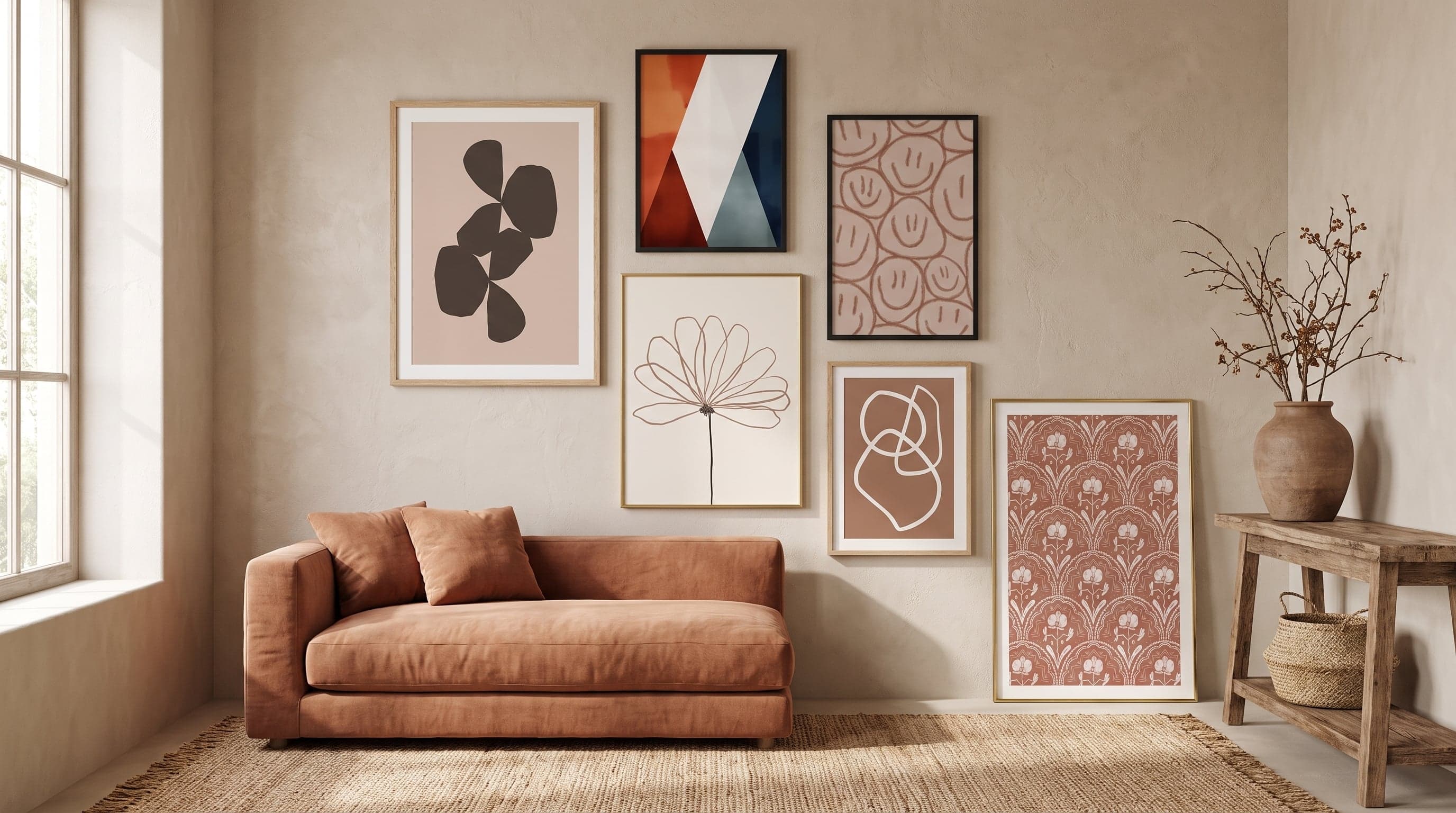
Ask someone what their interior style is, and the answer often comes out hesitant. "A bit Scandinavian, maybe, with some boho thrown in." The words we use to describe our own taste at home are rarely our own invention – they're borrowed from design history, fashion journalism and, more recently, social media. Over time they've hardened into categories we recognise without quite being able to put into words.
But styles can be read, and often more quickly in what we hang on the walls than in the furniture we choose. A coffee table rarely says as much about someone's eye as an art print does – colour choices, motifs and composition carry a style's signature more concentrated than almost anything else in the room.
This guide walks through some of the most common interior styles in Sweden right now: where they come from, what sets them apart visually, and what actually makes a style a style rather than just a passing trend.
Where do interior styles come from?
Most of the style terms we use today are historical borrowings. "Scandinavian design" was coined as an export term after the Second World War, when Nordic design was marketed internationally as functional and democratic. Bauhaus was an actual school in Weimar and later Dessau, founded in 1919, built on the idea that art, craft and industry should meet in simple geometric forms. Boho traces its roots to the 19th-century bohemian circles of Paris and found new life in the counterculture of the 1970s, with patterns and textiles drawn from all over the world.
Japandi and minimalism are more recent constructs – words that describe a feeling rather than a movement with a manifesto. That doesn't make them any less valid, but it explains why the boundaries between them sometimes feel blurred. A style is rarely a pure idea; it's a collection of visual habits that has eventually earned itself a name.
Scandinavian interior style: light, form and a certain calm
What's usually called Scandinavian style rests on the belief that light and simplicity go hand in hand. Pale wood, untreated surfaces, a colour scale that rarely raises its voice. The furniture has strong form but is rarely showy – the legacy of functionalism still shows in just how much weight is placed on shape itself.
On the walls, that translates into soft abstraction, organic lines and a palette that's muted without being dull. Geometry is welcome, but preferably without hard edges – more suggestion than statement.


Boho as an interior style: the decorative, earthy expression
If Scandinavian style is about taking away, boho is about adding – layer upon layer of pattern, texture and material that look as though they've been gathered over time rather than ordered all at once. The origins in Parisian bohemian circles live on in the attitude: a suspicion of the too-perfect, a pull towards the handmade.
The colour scale is warm and earthy, often in brown, terracotta and beige, with botanical motifs and patterns borrowed from different cultures and eras. It's a style that allows itself to be a lot, but rarely feels cold.


Minimalism and Japandi: the difference between stillness and emptiness
Minimalism and Japandi are often confused, but the difference lies in temperature. Minimalism is reduction in its purest form – function before decoration, a room where every remaining object must justify its place. Japandi borrows that discipline but blends in a Japanese appreciation for imperfection, wabi-sabi, along with a Scandinavian warmth in materials and light.
The choice of art therefore differs fundamentally. Pure minimalism favours a single motif, often in black and white or greyscale, with plenty of empty space around it. Japandi allows for more texture and a warmer tone, without ever becoming loud.


Bauhaus, art deco and geometric order
Bauhaus and art deco share a fascination with form, even though they emerged for different reasons. The Bauhaus school sought a universal, functional design language built on basic shapes and primary colours. Art deco, which developed in parallel through the 1920s and '30s, was more glamorous – symmetrical patterns, sharp lines and a sense of luxury rather than utility.
Both live on today through their visual language: repeated geometric patterns, clear outlines and a drive to organise chaos into structure. In a home, it usually shows up as graphic art with bold shapes, rather than in the silhouettes of the furniture.


Art as the interior style's clearest signature
Furniture is often chosen through compromise – price, space, what's already in the home. Art is rarely bound in the same way. It's where a person can allow themselves a colour they'd otherwise hesitate over, a pattern that breaks from the rest of the room, a motif with no other purpose than saying something about the eye behind the choice.
That's also why art is often the quickest way to test a direction before fully committing to it in furniture and materials. A bold, colourful print can signal a completely different attitude than the starkest of rooms – and sometimes it's precisely that contrast, the meeting of restraint and boldness, that makes a home interesting to be in.


Frequently asked questions
- How do I know what my interior style is?
- Look at what you already own and what draws you in shops or in photos – colour palette, choice of materials and degree of decoration usually reveal a direction even before you have a name for it. The art you're drawn to is often the quickest indicator, since it's rarely limited by practical considerations the way furniture is.
- Can you mix several interior styles?
- Most homes are, in practice, a mix. What holds an eclectic interior together is usually a common thread in colour scheme, material or feeling, rather than everything coming from the same category.
- What's the difference between boho and Scandinavian style?
- Scandinavian style is built on reduction and light, with a muted, cohesive palette. Boho adds layers of pattern, texture and earthy colour, allowing itself to be visually dense without ever feeling cold.
- Is Japandi its own style or just a trend?
- Japandi describes a distinct aesthetic combination – Japanese simplicity meeting Scandinavian warmth – rather than a passing trend. The term is younger than, say, Bauhaus or boho, but the visual expression it describes has existed longer than the word itself.