
Housewarming Gift – Art for the New Home
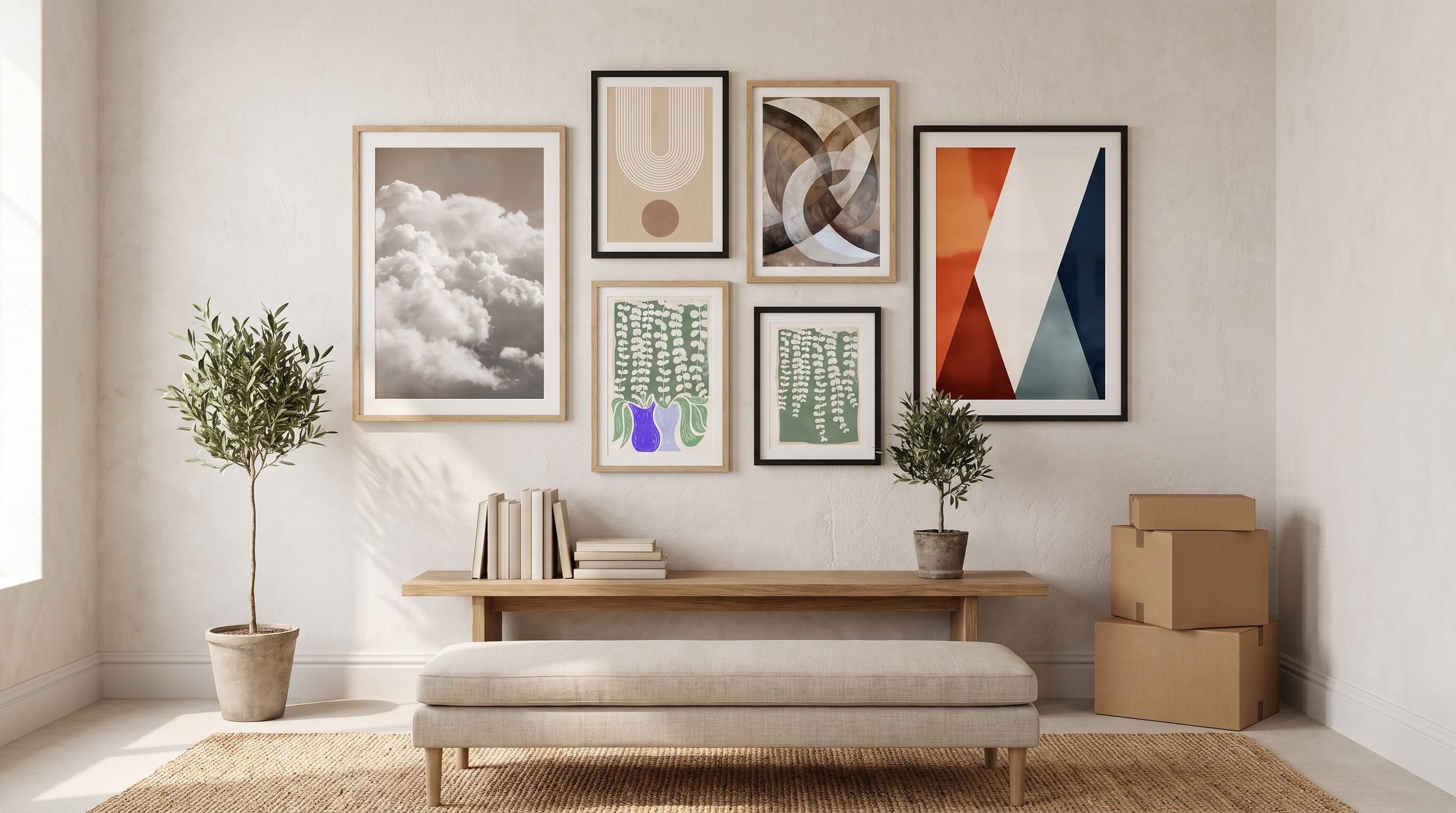
The first few weeks in a new home have a rhythm all their own. Furniture gets moved in before it finds its place, boxes linger longer than planned, and the walls stay bare long after the kitchen cupboards are full. It's in this phase that a housewarming gift of art does the most good – not as a box ticked off the moving checklist, but as something that remains once everything else has settled into shape.
Giving someone art after they've just moved is also a small gamble. You rarely know the new flat in detail – which wall gets the best light, what colours are already in the sofa, whether the person has even settled on a direction yet. That uncertainty makes many people hesitant about art as a gift. But it can be turned into an advantage, if you think carefully about what actually works before you know everything else.
It's less about guessing the exact right motif, and more about choosing something with room to grow into a home that's still taking shape. If you want to explore the idea of art as a gift more broadly, there's a guide to giving posters as gifts to lean on.
The Room You Don't Know Yet – Choosing Art for an Unfamiliar Wall
Someone who's just moved rarely knows themselves what their walls will look like in six months. Furniture finds its place over time, the colour scheme gets adjusted along the way, and what feels right during moving week can feel wrong once the evening light falls differently in autumn. Giving art as a gift in that situation is therefore less about hitting an exact style, and more about choosing something that doesn't lock the room into one direction.
Bold, attention-grabbing colours are the hardest to get right in this context. A field of saturated orange or a sharp contrast can become the star of the wall – beautiful if it fits, difficult to work around if it doesn't. Softer, more neutral expressions leave more room to breathe. Abstract motifs in beige, sand and blue-grey tones, ideally with simple geometric shapes, work in most settings without demanding that the rest of the room adapt to them.


Green and Blue as Common Denominators in Botanical Prints
If neutral abstraction is a safe bet, botanical motifs are almost as hard to get wrong – and considerably warmer. Green works against virtually any wall colour, and botanical prints have a knack for feeling right at home whether the rest of the flat leans towards spare Scandinavian style or something more maximalist. A leaf, a branch, a simple bouquet – these are motifs that don't compete with the rest of the room, but settle in alongside it.
Blue is the other colour that rarely goes wrong in a home you don't fully know yet. Flowers rendered in blue and blue-grey tones share the same calm quality as green motifs, but with a bit more depth – they work just as well in a bedroom as in a hallway, and age gracefully even as taste shifts over time.


Art History as Common Ground When You're Unsure of Taste
Another way to navigate the uncertainty is to lean on things that have already proven themselves over time. Classic painting traditions – Monet's water reflections, Van Gogh's brushstrokes – carry a recognisability that works regardless of which direction the new resident's décor eventually takes. It's not about playing it safe, but about choosing motifs that have already proven themselves across a huge range of settings over a very long time.
This kind of gift also suits anyone who wants to avoid betting on a trend that might feel dated in a few years. An art-historical motif relates to something bigger than the interior fads of the moment, which makes it easier to give with a bit of confidence – even to someone whose taste you don't fully know yet. Anyone who wants to read more about how art works as a gift in general can find more in the guide to posters as gifts.


Choosing Without Asking Outright – Room, Size and Format
Of course, you could simply ask the new homeowner what they want on their wall. But part of the charm of art as a gift lies in the fact that it wasn't requested in advance – it's a suggestion, not an order. One way around the uncertainty is to think in terms of rooms rather than style: a piece for the hallway or bedroom is often easier to get right than one for the living room's most visible wall, since smaller spaces tend to carry fewer expectations.
Size matters too. A smaller format doesn't require a fixed spot right away, and can be moved around until it finds its wall – which suits the shifting phase a newly moved-into home is actually in. Anyone who feels unsure rarely goes wrong by choosing something that doesn't demand an immediate, definite answer. More thoughts on the practical side of giving art as a gift can be found in the guide to posters as gifts.
Frequently asked questions
- What's a good housewarming gift if you don't know what the flat looks like?
- Neutral, abstract motifs in earthy or blue-grey tones, along with botanical illustrations in green or blue, are safe choices since they rarely clash with an already established décor. They work as an addition rather than a statement that demands the rest of the room adapt.
- Should you ask the new homeowner about their taste before buying a print?
- You can ask, but part of the point of giving art is that it gets to be a suggestion rather than an order. If you choose a motif with broad appeal, you rarely need to check in advance.
- What size works best as a gift for a new home?
- A small or medium format is often easier to give, since it doesn't require a fixed spot right away. The poster can move around the home until it finds its wall, which suits a phase where so much is still in flux.
- Do you need to frame the print before giving it as a gift?
- No, it's perfectly fine to give a poster unframed. Many people prefer to let the recipient choose the frame and finish once they've decided where it will hang.