
Posters for the Home Office – Art That Makes the Workday Better
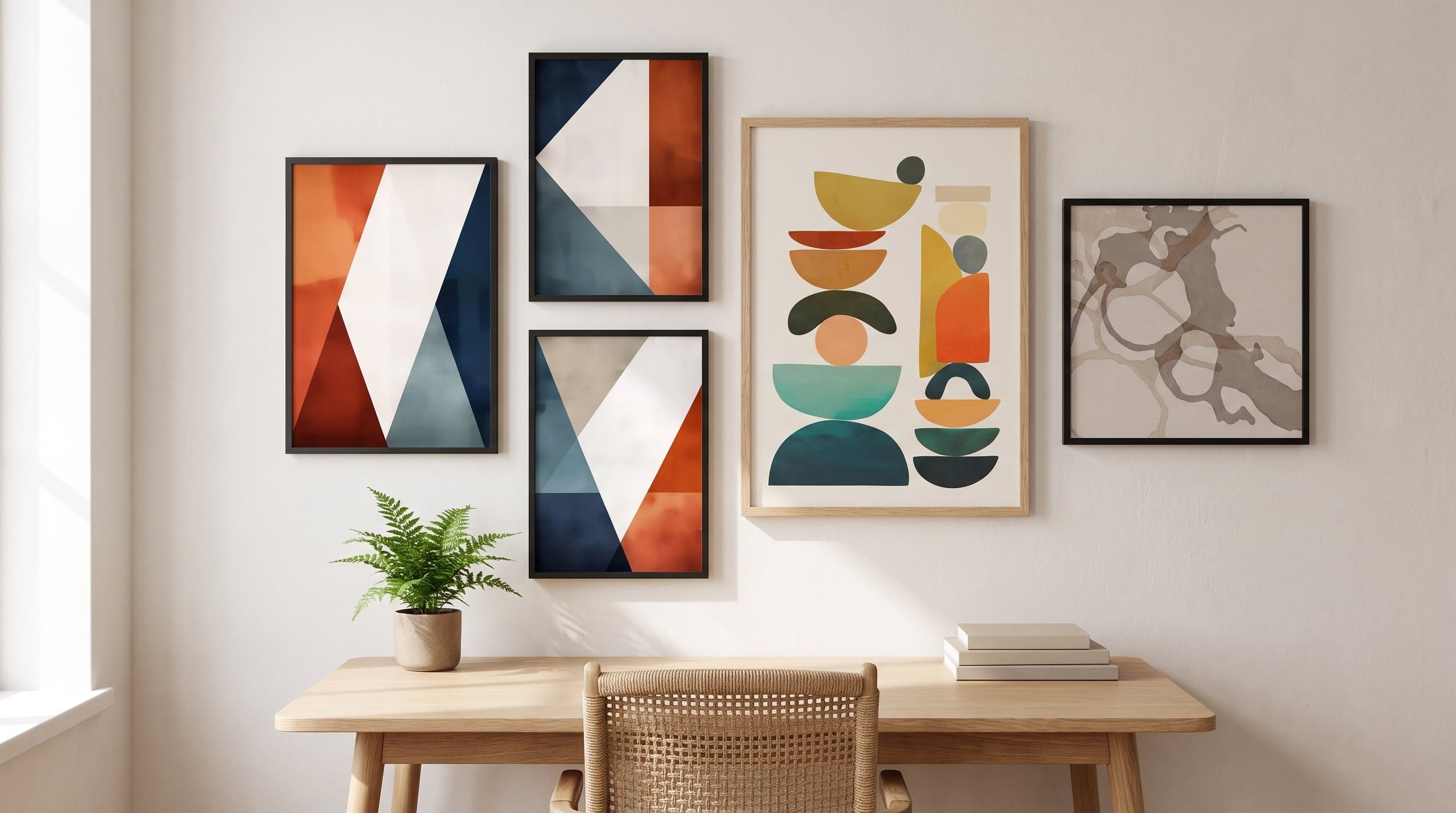
The home office is a room that rarely got any architecture of its own. It's been squeezed into a bedroom corner, a hallway, a former guest room – and yet it's expected to carry the full range of the working day: concentration, meetings, breaks, those moments when your eyes need somewhere other than the screen to rest.
Unlike an office landscape shaped by someone else, the home office is largely self-chosen. That makes the choice of art more personal – and more consequential. What you put on the wall doesn't just shape the feel of the room, it shapes how you experience the workday itself: whether your gaze meets something that sharpens thought, softens the pulse, or simply reminds you that there's a life beyond the inbox.
This guide is meant to open up those choices rather than hand you a definitive answer for home office posters. Home offices look different depending on what happens in them – writing, design, bookkeeping, video calls – and art that works for one task can feel wrong for another.
Light and calm at the desk
The first thing to consider is often light – both the physical light in the room and the light the art itself contributes. A home office facing north, or a room without much window space, often benefits from motifs that add brightness rather than absorb it: pale blues, greys, soft geometric shapes that ask nothing of the viewer.
Geometric motifs in blue and grey tones turn up in a lot of workspaces, and a reasonable explanation is that they offer structure without demanding interpretation. Blue is often described as a colour that brings calm without feeling sedating – though of course that's highly individual. Unlike a photograph or a scene with a clear narrative, these works don't ask for attention. They simply exist in the periphery, keeping the room still.


Focus and clarity in the workspace
When a task demands deep concentration – long stretches of writing, coding, analysis – art takes on a different role. Here it's less about catching the eye and more about not pushing it away. Abstract works with recurring shapes or markings function, for many people, as a neutral backdrop: something the eye can rest on without the mind being pulled into a story.
Works that move in the space between structure and feeling – interlinked lines, tight compositions, soft fields of colour – keep a room settled rather than stimulated. This isn't art meant to impress whoever walks in; it's art meant to coexist with whoever sits there for hours on end.


Words to work by – typographic posters
Not everyone wants silence on the wall. Some home offices work better with something that actually says something – a quote, a line, a comment on the more absurd sides of the working day. Typographic posters function as a kind of inner dialogue, a reminder aimed at yourself rather than at whoever might step into the room.
The range is wide: from restrained, almost whispered phrases to bold, colourful statements that announce themselves from the doorway. Which tone fits has less to do with taste in general and more with what kind of day you want to be reminded you're capable of having.


Posters for creative professions and personal references
For anyone working with image, sound, design or other forms of expression, the home office easily becomes an extension of the profession itself – a room where references, favourites and personal interests can take up space on the wall without needing to justify themselves. A vinyl record, a cityscape photographed at dawn, a piece of fruit drawn with botanical precision: things like this say something about who works there, rather than dictating how the work should be done.
It's also a way to hold on to a sense of curiosity in a room that otherwise easily becomes purely functional, and a bit too tidy.


Recovery in the margins of the workday
A home office rarely needs to be focused in every corner. The chair you move to during a phone call, the wall behind the screen you see when you lean back, the spot your gaze lands on between meetings – these parts of the room can carry something softer: textures, muted colours, motifs that don't demand interpretation but still give the eye something to look at.
Marbled patterns, soft abstract fields and muted compositions in white and blue often work well in exactly that role. They're not meant to be analysed, just to exist as a kind of visual pause.


Finding your own balance at the desk
There's no fixed formula for how a home office is best furnished with art. Some want a single strong statement that sets the tone for the whole room; others prefer a more layered wall where different moods coexist – something calming, something that challenges, something that's simply beautiful to rest your eyes on.
Perhaps the most important thing to remember is that the room changes along with the workday. What feels right during an intense deadline isn't always what feels best at four o'clock on a quiet Friday. Allowing yourself to test, swap and reconsider is part of actually furnishing a workspace – not just decorating it.
Frequently asked questions
- What kind of poster works best for tasks that require concentration?
- Many people find that restrained, abstract motifs disturb the mind less than images with a clear narrative, since they don't demand the same kind of interpretation. That said, it's individual – some work just as well with something that occasionally catches the eye and offers a brief pause.
- How high should posters be hung in a home office?
- A common starting point is to position the bottom edge roughly at eye level while seated at the desk, rather than standing, since that's the position from which you usually view the room.
- Do bold, colourful posters work in a small workspace?
- Yes, but preferably in a smaller format or as a single eye-catcher rather than several bold statements at once. In small rooms, colour and pattern take up more visual space – which can be exactly what's needed, or too much, depending on how you personally respond to visual stimulation during the workday.
- How many posters are right for a home office?
- It depends entirely on the size of the room and the available wall space. A single strong piece can be enough to set a tone, while a collection of two to four posters often brings more variation in expression and mood throughout the day.